

Law firm marketing for small NSW firms: the referral still googles you
Guides Leads & Conversion Professional Services
Referrals bring your name, but the referred client checks you on Google before they call. A 30-minute check, what a new matter really costs, which channel to add first and the NSW rules your principal signs off on.
Picture a woman with a lease problem. Her sister-in-law says, “Call Mia at Hart & Co, she sorted ours.” It’s 9pm, so she types “Hart & Co lawyers” into Google instead. The website looks like it was last touched for the GST launch, there are three reviews, and nothing on the site mentions leases. Two results down, another firm has a page called “Landlord won’t return your bond? What happens next”. She rings them in the morning. (A made-up example, but a common pattern: the referral creates the search, and the search decides the next step.)
That’s the part of law firm marketing most small practices never see. The referral did its job. It brought your name. Google decided the call.
My view, as someone whose own agency runs on word of mouth: referrals are still the best clients a small NSW firm gets, and the worst place to stop. Below is the 30-minute check a referred client effectively runs on you, how to work out what a new matter really costs, which channel I’d add first, and the NSW rules your principal has to sign off on.
Law firm marketing starts with the referral, but Google decides the call
Small practices still run on referrals. A Smokeball survey reported by Lawyers Weekly found small firms still lean on them heavily, which fits how most boutique practices win work. I’m not going to tell you to stop. A client sent by someone they trust arrives warmer than any ad can make them.
The catch is that a referral is a name, not a decision. Between “call Mia” and the phone ringing, people check. They search the firm, look at the Google Business Profile, skim the reviews and look for a page about their problem. If what they find is thin, the referral weakens. If a competitor’s page answers their question better, it can switch.
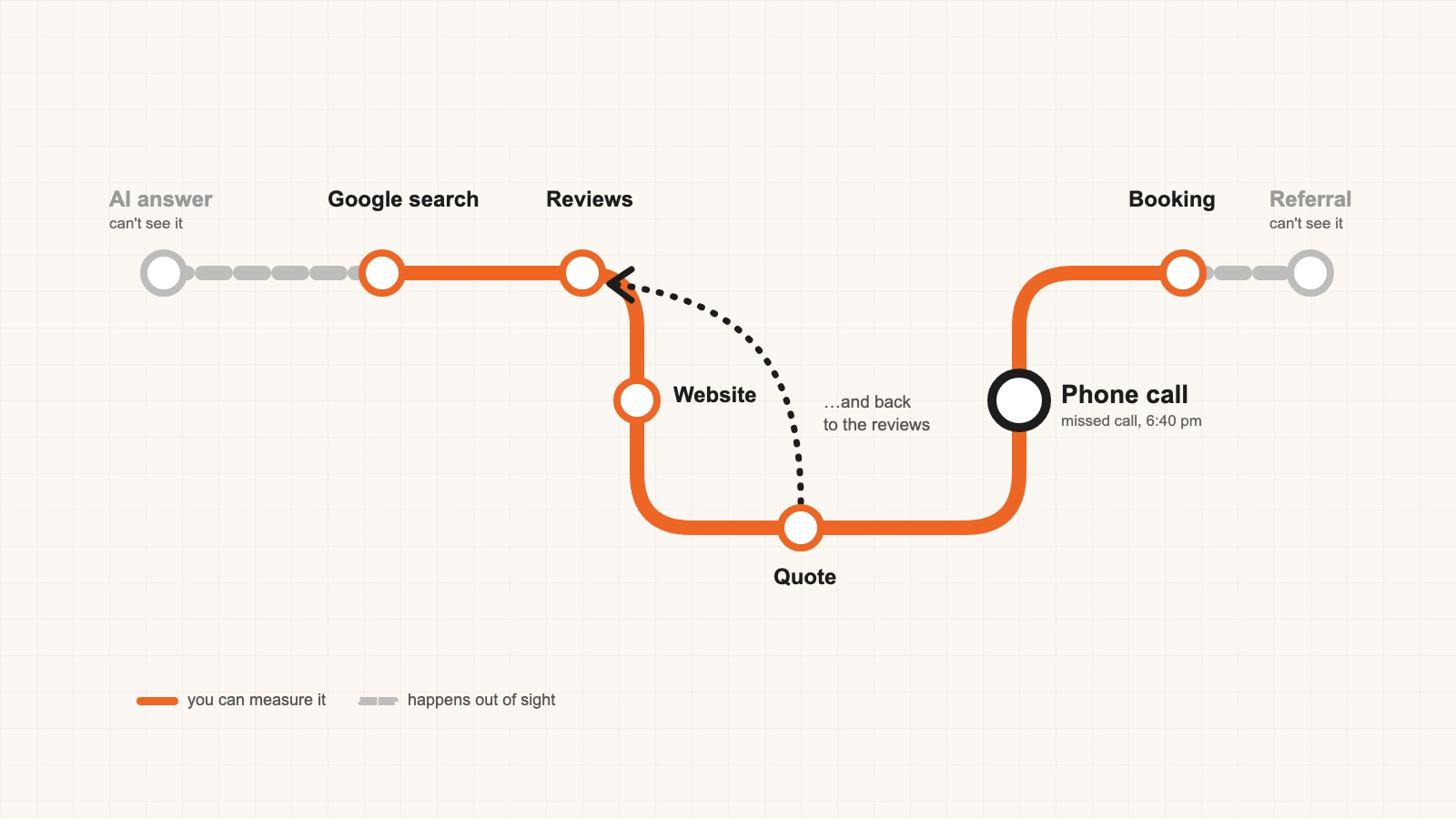
What the animation shows: a friend tells a woman to call Hart & Co, a made-up firm. That night she searches its name and finds an out-of-date site, three reviews and nothing about leases, while another firm has a page about exactly her problem, so that’s who she calls. Once Hart & Co fixes the things she checks, the same referral turns into a call to them.
So I’d stop treating referrals and online marketing as two separate things. For a small firm, the website and the Google profile are where referrals get confirmed or lost. Marketing for lawyers, at this size, is mostly about making that confirmation easy.
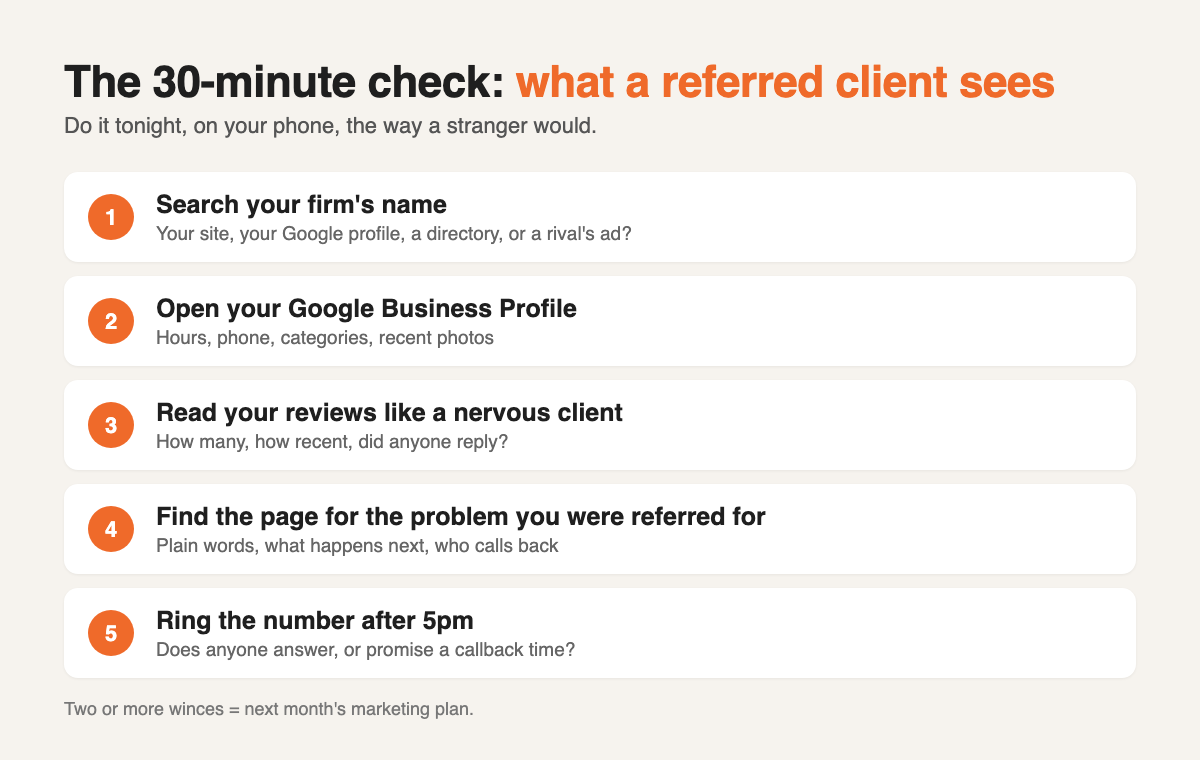
The 30-minute check a referred client runs on you
Do this tonight, on your phone, the way a stranger would. Thirty minutes is plenty.
- Search your firm’s name. What comes first: your site, your Google Business Profile, a directory, or a competitor’s ad? You may also spot a rival’s ad above you for your own name, although ads vary by location and device.
- Open your Google Business Profile. Check the hours, the phone number, the categories and the photos. Google says local results are based on relevance, distance and prominence, and reviews are part of prominence.
- Read your reviews as a nervous client would. How many, how recent, and did anyone reply? Replies need care, because a reply shouldn’t confirm that the reviewer is your client.
- Find the page for the problem you were referred for. Not “Property law services”. A page that names the situation in plain words, says what happens next and who’ll call back.
- Ring the number after 5pm. Does anyone answer? Is there voicemail with a promise of a callback time? A referred client who hits a dead line often tries the next firm.
This is the thinking behind the lead funnel we built for Chapman Solicitors, a strata and property practice. People with a strata dispute rarely search for a generic law firm, so we built a focused landing page and a short video that put Joel Chapman himself in front of them. The person who’s been told “try Joel” lands on a page that proves it’s the right call.
Juris Digital’s three-minute interview with US attorney Erin Bailey makes the same point from the lawyer’s side: you can’t market your way out of bad service, so reviews start with how clients are treated.
If two or more of those five checks made you wince, that’s your marketing plan for the next month. It’s less glamorous than a rebrand and far more likely to pay.
What a new matter really costs you (count your own hours)
Most small firms can tell me what they spend on ads. Very few can tell me what a new matter costs. The difference is usually the partner’s time, which never shows up on an invoice.
The sum I’d use is deliberately simple:
Cost per new matter = (ad spend + agency and software fees + your hours on marketing × what an hour of your time is worth) ÷ new matters signed from marketing.
A hypothetical, not a client’s numbers: a two-partner firm spends $1,500 a month on Google Ads, $500 on software and a website retainer, and one partner spends eight hours a month on posts and networking lunches, valued at $350 an hour. That’s $4,800. If marketing brings in six new matters, each one costs $800. Whether that’s good depends entirely on what a matter is worth to you, which is why I don’t trust anyone quoting a budget as a percentage of revenue without asking.
Counting matters rather than visits matters more than it sounds. When we worked with JFM & Co, a boutique Sydney employment firm, website visitors rose 270% and leads rose 38% over the 2010–12 campaign. Both are good numbers. But if the firm had judged it on traffic, it would have expected seven times more work than actually came through the door. It’s an old result and not a benchmark for anyone else; the lesson that carries over is to count signed matters.
To count them, you need to know where each enquiry came from. That means a “how did you hear about us?” question at intake, call tracking if the phone is your main channel, and a simple record in your CRM of which enquiries became matters.
SEO, Google Ads or referral partners: which to add first
You don’t need six channels. Once the 30-minute check is fixed, add one, and pick it by how fast you need work:
- You need enquiries this month: tightly targeted Google Ads on the problems you handle, not on “lawyers Sydney”. I’ve written up how in Google Ads for law firms.
- You can wait six to twelve months for something that compounds: SEO built around your clients’ problems, one useful page per situation. That’s SEO for law firms.
- Your best work comes from other professionals: make referring easy. A one-page summary of what you take on, a direct number, and a note back to the referrer (with the client’s consent) when you’ve helped.
Where I could be wrong: in some practice areas, a strong generalist name built over decades beats everything here. If that’s you, protect the name and fix the five checks anyway.
The NSW rules your principal signs off on
Pulse isn’t a law firm and this section isn’t legal advice. Treat these as marketing risk prompts for your principal or adviser to check against current NSW rules and Law Society guidance. They’re the ones I raise before any law firm page goes live:
- No misleading claims. The Law Society’s guidance on advertising legal services says ads can’t be false, misleading or deceptive. Past results should be accurate and in context, never presented as what every client can expect.
- “Specialist” is earned. A solicitor shouldn’t present as a specialist without Law Society specialist accreditation. Describe the work instead: “we act for owners in strata disputes”.
- Client stories need consent. Case studies, testimonials and review replies shouldn’t identify a client unless they’ve agreed, ideally in writing.
- Personal injury firms, be careful buying leads. NSW’s 2025 claim farming laws target the buying, selling and soliciting of certain personal injury claims. Get advice before signing any lead-buying or referral deal.
None of this makes marketing harder for a good small firm. It rules out the shortcuts that big-budget advice tends to assume.
Law firm marketing for the next 30 days
If I were running marketing for a small NSW practice, this month would look like this:
- Run the 30-minute check and fix the two worst findings.
- Write one page for the problem you’re most often referred for, reviewed by the lawyer who handles it.
- Ask every client from the last three months for an honest Google review, the same way whether you expect praise or not.
- Add “how did you hear about us?” to intake and start counting signed matters by source.
- Only then, choose one channel from the list above.
One question to take away: when someone is told to call you, what do they find when they search your name tonight? If you’d rather have someone run that check with you and set up the tracking, that’s our lead generation work: talk to us, or see how we work with law firms and other professional services.
Pulse Agency is a marketing agency, not a law firm. Examples in this article show the kind of content a firm might publish; they’re not legal advice and aren’t about anyone’s situation.
Frequently Asked Questions
What is law firm marketing?
Law firm marketing is everything that helps the right clients find, trust and contact your practice: your website and practice-area pages, Google Business Profile and reviews, referral relationships, search and ads, and how quickly someone answers the phone. For a small firm, it’s mostly about making sure referred and searching clients find a clear reason to call you.
How much should a small law firm spend on marketing?
There’s no reliable percentage, and the benchmarks you’ll see quoted rarely have a source. Work it out the other way: what does a new matter cost you, including your own hours, and what is one worth? If marketing brings in matters at a cost well below their value and you have capacity, spend more; if you can’t measure it, fix that first.
Do referral-based law firms need marketing?
Yes, though not necessarily ads. Referred clients usually search your name before they call, so your Google Business Profile, reviews, practice-area pages and phone answering decide whether the referral turns into a matter. Fixing those protects the work you’ve already earned.
What does a law firm marketing agency do?
A good one starts with how your clients find and judge you, then fixes your website pages, Google profile, tracking and intake before adding SEO or Google Ads. It should report on enquiries and signed matters, not just clicks, and leave legal and compliance decisions to your principal.
When should a small firm hire a law firm marketing agency?
When the partners’ time is worth more spent on legal work than on websites and ads, or when you need results faster than you can learn the tools. Before hiring, ask how they’ll measure signed matters and how they handle NSW advertising rules.