
Digital marketing for universities: your grad cert doesn’t need a campus tour
Most university marketing advice is written for undergraduate admissions. This guide is for faculties filling postgraduate and professional programs: program pages, intake-timed search ads, career claims you can prove, follow-up to admissions and enrolments by program.
To: the faculty marketing lead with a program below target
From: Nico, Pulse
Re: digital marketing for universities, one program at a time
Search “digital marketing for universities” in Australia and most of what comes back is undergraduate admissions advice from the US and UK: campus tours, TikTok plans and how to win over parents. Fair enough if you’re filling a first-year intake.
It’s close to useless for your job: a Graduate Certificate below target, an intake closing soon, a dean asking which ads produced enrolments, and prospects who already have a job, a mortgage and a manager to convince.
Postgraduate programs get filled one at a time. Most faculties still run a brand play for something people buy the way they’d choose a home loan: slowly, with comparison tabs open and someone else signing off. Stop doing that tomorrow.
Below is the program-level plan I use for Pulse’s work in marketing for universities and training providers, in the order a prospect meets it: the page, the ads, the career content, the follow-up and the measurement.
Digital marketing for universities works program by program, not brand-first
Your grad cert buyer is a working adult studying part-time or online around a full-time job. Sometimes the employer pays. Often they’re weighing up FEE-HELP, the Australian Government loan for eligible students in full fee-paying places at approved providers.

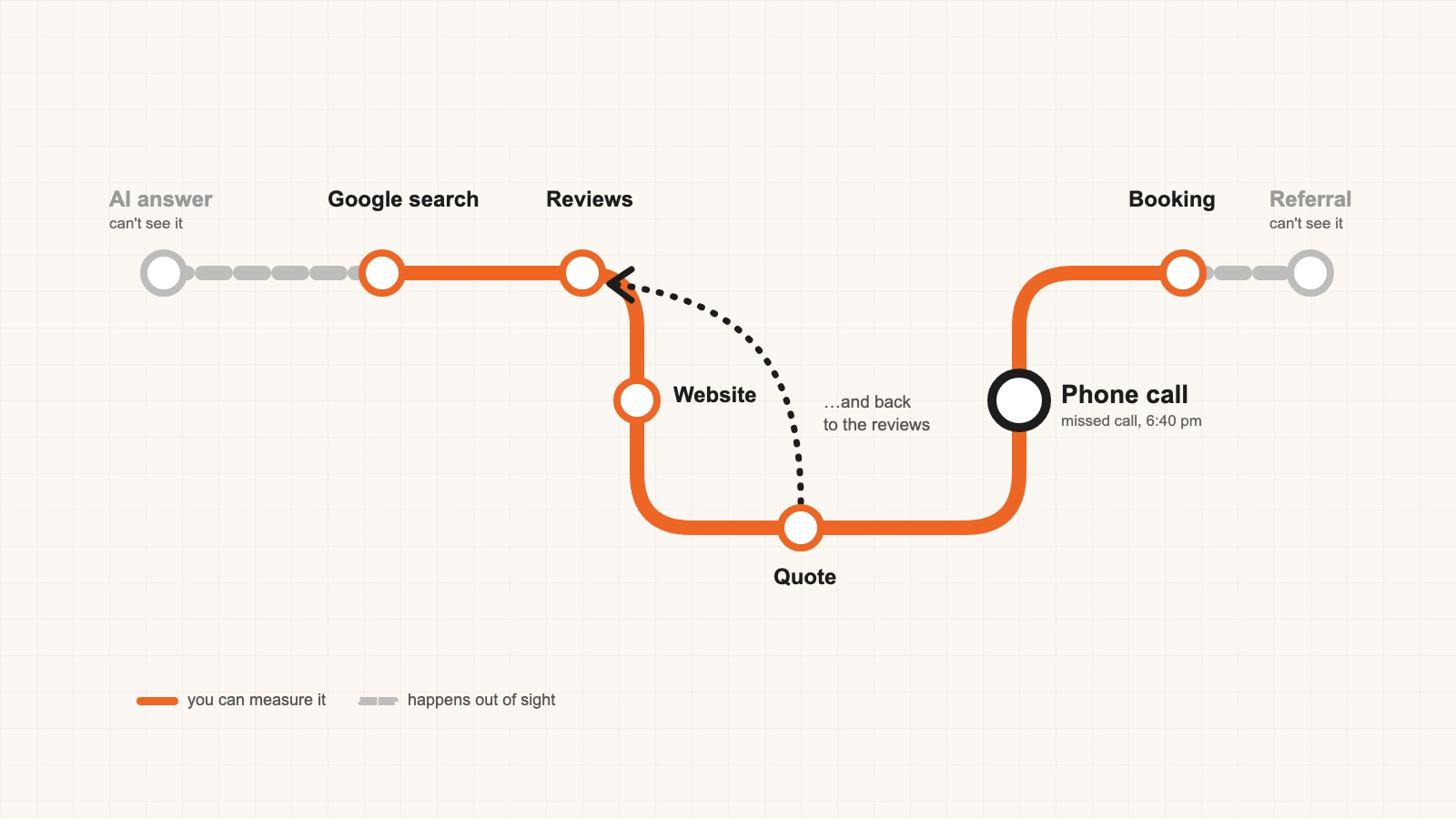
That makes a postgraduate qualification closer to a mortgage than a festival ticket: researched for weeks, compared side by side, talked over at the kitchen table and signed off by someone else. Map the months between first search and enrolment before you buy a single ad.
You already know the org chart doesn’t help. The faculty owns the program and its target; central marketing owns the brand. The “bigger brand campaign” fix often comes from the part of the building that doesn’t carry the enrolment number. Reputation gets you onto the shortlist, but it can’t tell a project manager whether the workload fits around her job, or whether her industry experience counts towards entry.
Brand gets you considered. The program page, the intake-timed ad and the follow-up get you enrolled.
SEO for universities starts with one strong page per program
People search for the qualification, not your university’s values: “graduate certificate in project management online” or “master of data science part time”. Those are illustrations, not keyword data; your own Search Console will show the pattern.
Each program needs one strong page that ranks for those searches and answers the real questions. The regulator has already written half your brief. TEQSA’s commentary on Standard 7.2 of the Higher Education Standards Framework expects providers to publish:
- course design and structure
- the factors in selection, with enough detail to estimate realistic prospects of admission
- all fees, charges and HELP liabilities
- the student support on offer
- any professional accreditation
Then add what working adults check first: intake dates, part-time load, delivery mode, who teaches and career outcomes you can back up. Say whether RPL (recognition of prior learning, credit for study or work already done) applies. Give each question its own heading and a plain answer, which snippets and AI summaries can quote. This is the unglamorous core of SEO for program pages.
Don’t: “Master of Data Science. Shape the future. Join a world-class community of innovators. Enquire now.”
Do: “Master of Data Science, part-time or online. [Duration]. Next intakes: [months]. Fees: [per subject and total]. FEE-HELP available for eligible students. Entry: [criteria, including work-experience pathways]. Taught by [named academics]. Accredited by [body, if applicable].”
The first sounds lovely and answers nothing. The second lets a tired professional decide in a minute.
What the animation shows: A working professional on the train home has three questions about a graduate certificate: fees, part-time study and the next intake. The university page answers with “Shape the future” and a campus tour button, and the commuter nods off. Then an example program page answers all three on the first screen, with FEE-HELP and a March intake.
Search ads on program names should follow the intake calendar
Run Google Ads on program names people actually type, with phrase and exact match (match types control how closely a search has to match your keyword). Skip broad terms like “postgraduate study”.
Ramp up around each intake’s application window instead of spreading activity evenly. Treat the intake closing date like 31 October at tax time: ignored for months, then suddenly urgent.
Don’t: “World-class postgraduate education. Apply now.”
Do: “Grad Cert in Project Management, online, part-time. [Month] intake open. FEE-HELP for eligible students.”
For professional and executive programs, LinkedIn earns its place: its ad targeting covers job title, function, seniority, years of experience, skills and company. If your faculty runs short courses too, the guide on marketing short courses with a start date goes deeper on LinkedIn and Meta.
The position behind an ad matters more than its words. Pulse’s work with UTS FEIT on professional education covered short courses, not postgraduate programs, but the method transfers. We agreed three personas with UTS (team leaders upskilling staff, professionals keeping skills current, past short-course students) and mapped the real alternatives: other universities, specialist trainers and bootcamps. The position, one-day courses taught by UTS experts on campus in Sydney, shaped every ad and landing page. Facebook remarketing to people who’d already viewed a course converted several times better than cold audiences.
The career question is the one your content keeps dodging
Your prospect’s real question is blunt: what will this do for my career, and will my manager back it? Most program content answers with adjectives.
The QILT Graduate Outcomes Survey put the full-time employment rate for postgraduate coursework graduates at 88.3% in 2025, four to six months after finishing. QILT notes a 2025 change in how the labour force is defined, so don’t build a trend story on it. Linking to ComparED, which compares institutions on student experience, shows you’re not afraid of comparison.
Career claims about your own program have to be provable. TEQSA’s commentary on Standard 7.1 names marketing claims about career outcomes. The ACCC says a business must be able to prove any claim it advertises, including testimonials and what staff say, and intent doesn’t matter.
So publish a “make the case to your employer” page, graduate stories shared with consent, and role or skill outcomes the faculty can document. Drop “accelerate your career” with nothing underneath it.
The biggest leak sits between faculty marketing and admissions
Marketing counts the enquiry. Admissions owns the application. In between, the prospect often gets a generic brochure, or nothing. That gap is where postgraduate recruitment quietly leaks.
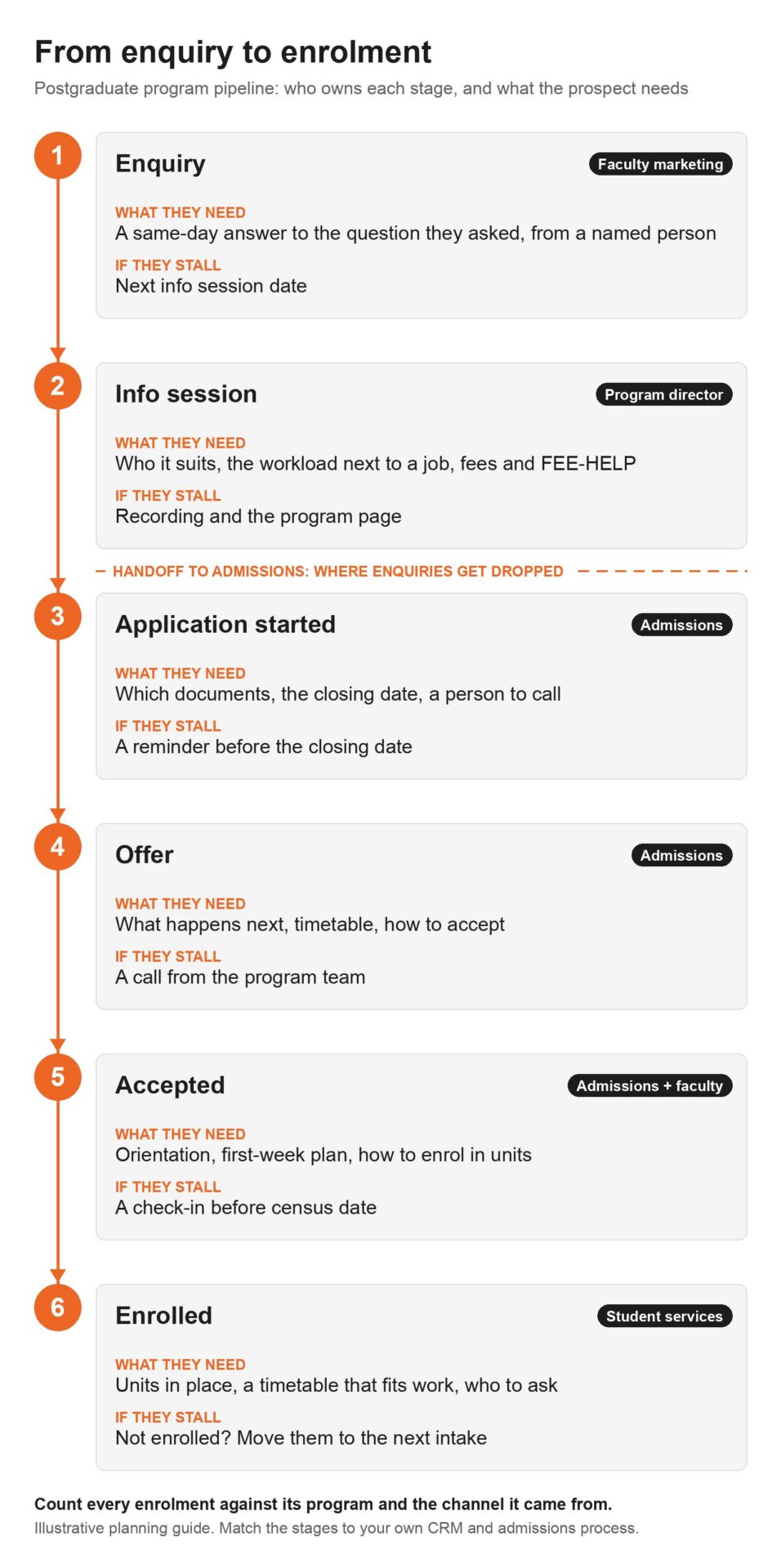
Picture a project manager who enquires on a Sunday night. She wants to know whether her employer can pay and whether her work experience counts for entry. Monday she gets a brochure. By the time admissions hears her name, she’s accepted an offer elsewhere. If someone enquired about your Graduate Certificate last Tuesday, who in your university knows what happened to them?
Give every stage a named owner and an answer to what the prospect needs right then: a reply to their actual question, the next info session, employer-case material, clarity on entry and RPL. Your CRM should carry the enquiry, its source and its program into the admissions record, with stages tied to a program and an intake.
Follow-up for a months-long decision is a sequence: intake reminders, career content, a chat with the program director, and a move to the next intake for anyone not ready. That’s what CRM and marketing automation is for in a faculty: not more emails, fewer dropped people.
International student recruitment has rules your ad copy has to follow
If a program is offered to overseas students, the rules shape the marketing itself. The Department of Education’s factsheet on National Code Standard 1 says marketing must not be false or misleading, and must be consistent with Australian Consumer Law.
All written and online material that offers or invites overseas students to a course must include your CRICOS registered name and registration number. (CRICOS is the Commonwealth Register of Institutions and Courses for Overseas Students.) You can’t promise migration outcomes or guarantee education assessment outcomes, and you can’t give false information about prerequisites, including English. TEQSA also expects you to contract, inform and monitor education agents, and to control how third-party websites present you. Build these rules into your ad and landing page templates, and confirm with your legal and compliance team which programs and channels they cover.
Digital marketing for universities is measured in enrolments, not enquiries
If you can’t see enrolments by program and channel, you can’t move effort to what works. Counting enquiries is a real estate agent counting open-house visitors.
The fix is offline conversion imports. Google Ads Help explains how to send conversions recorded elsewhere, such as an enrolment in your CRM, back into Google Ads. You capture the Google click ID (the unique identifier added to each ad click when auto-tagging is on) at enquiry and carry it through to admissions.
Report per program, per intake: enquiries, applications, offers and enrolments, by channel. In the UTS FEIT work, dashboards showed which audiences and channels drove enquiries and helped the team adjust its course portfolio; the conversion rate rose 54% over the campaign period (short courses, remember, not postgraduate).
Marketing doesn’t control admissions, fees or timetables, I know. So report jointly, and bring your privacy team in early, because admissions data has rules of its own.
What I’d ask you to do this month
Pick one program, not the whole portfolio. Which one is furthest below target for the next intake? Does its page answer the fees, time and career questions on the first screen? And who owns the enquiry the day after it arrives?
Answer those three and you’ve got a plan. For a second pair of eyes on the program that has to fill next, talk to Pulse about education marketing.
Questions faculty marketers ask
What is digital marketing for universities?
It’s the use of search, social, email and content to attract and enrol students. For postgraduate and professional programs, it works best program by program: a page answering fees, time and career questions, search ads timed to each intake, and follow-up that reaches admissions without dropping the enquiry.
What is student recruitment marketing?
It’s the marketing that moves a prospective student from first search to enrolment: ads, program pages, info sessions, email follow-up and the handoff to admissions. For a university faculty, success is measured in enrolments by program and intake, not in enquiries, clicks or brand awareness alone.
What must Australian universities include when marketing to international students?
Under National Code Standard 1, written and online material offering courses to overseas students must include the provider’s CRICOS registered name and number. It can’t promise migration outcomes, guarantee assessment outcomes or misstate prerequisites such as English. Confirm the specifics with your university’s legal and compliance team.