
How to get NDIS clients: be easy to refer, then easy to check
Most new NDIS clients arrive through someone the participant already trusts. What support coordinators, families, LACs and plan managers check first, which directories fit your business, and why referral rewards are now an inducement risk.
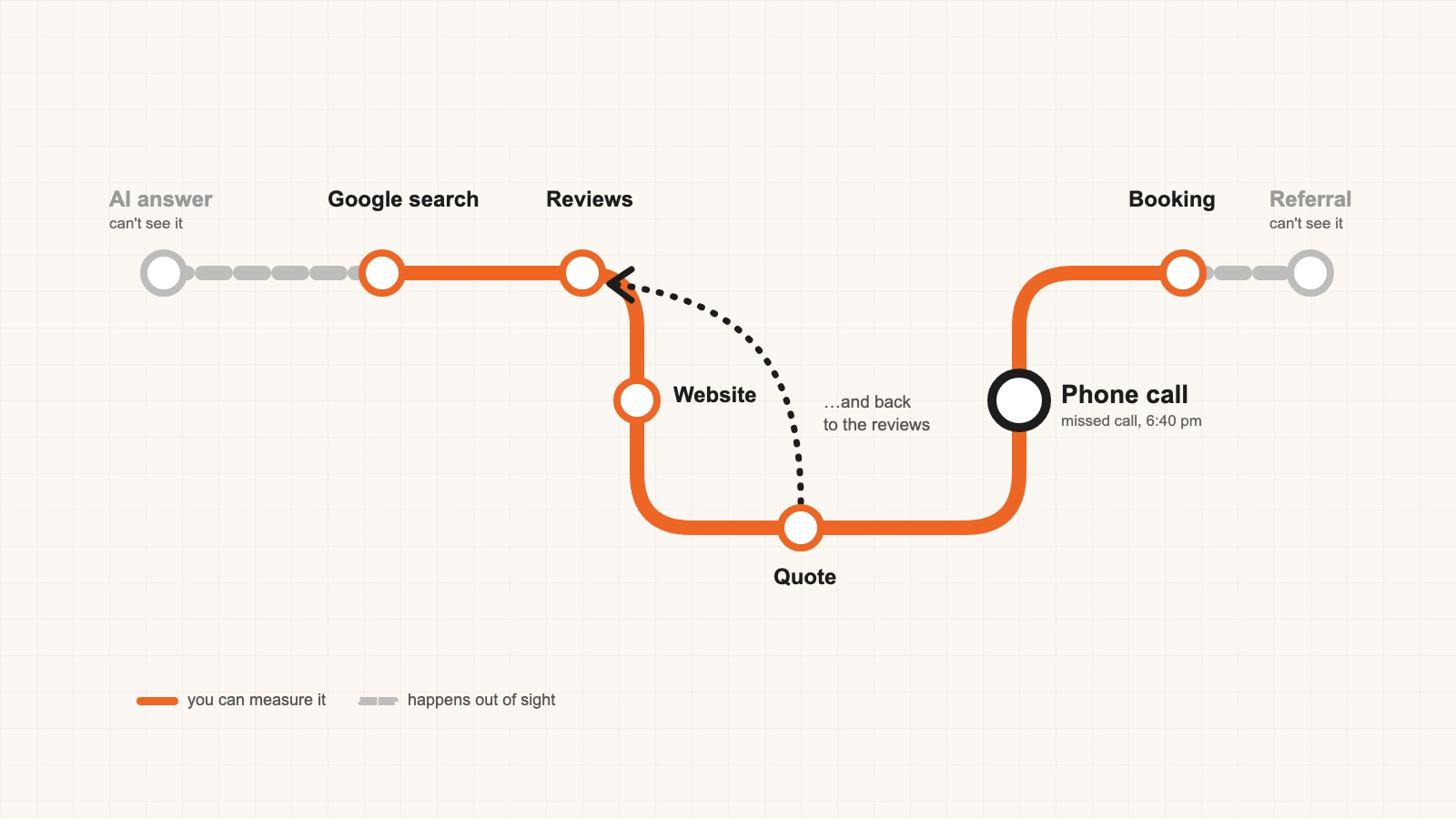
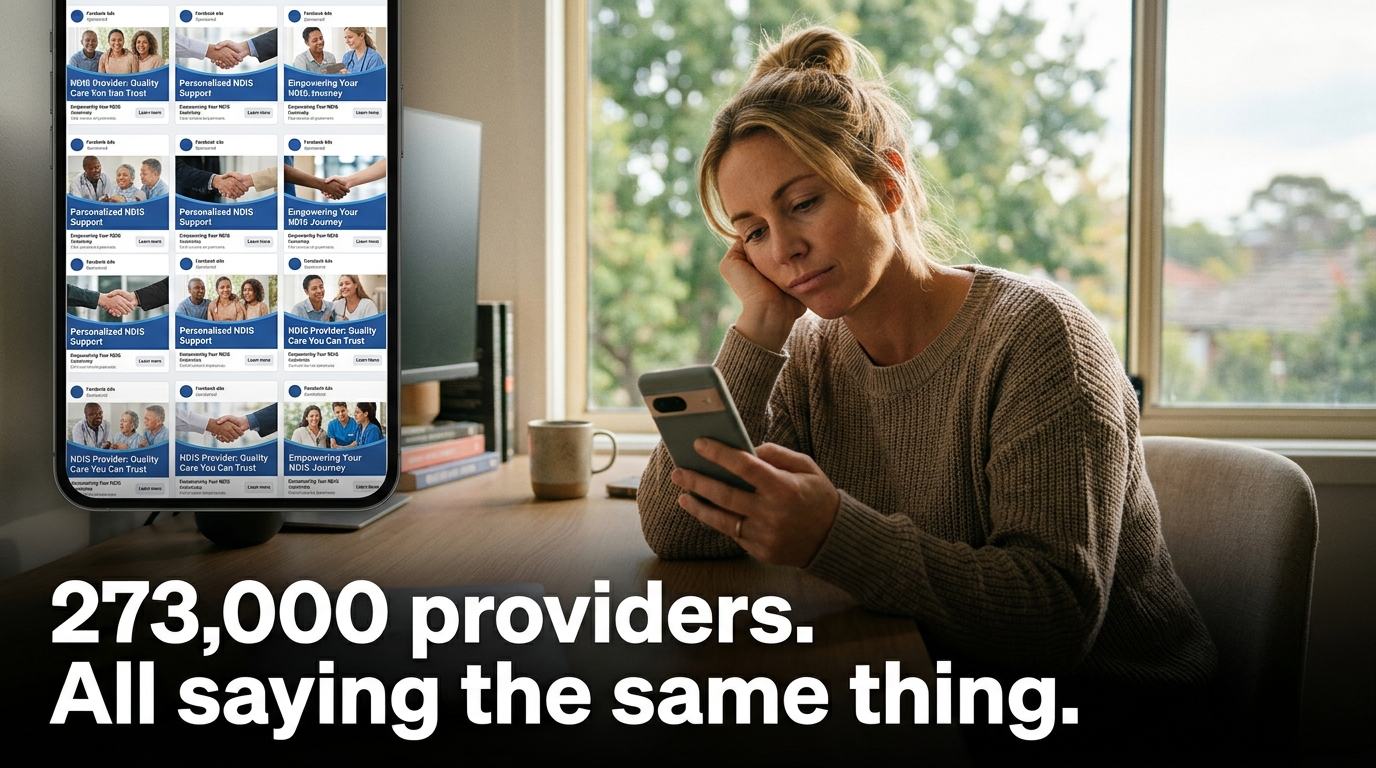
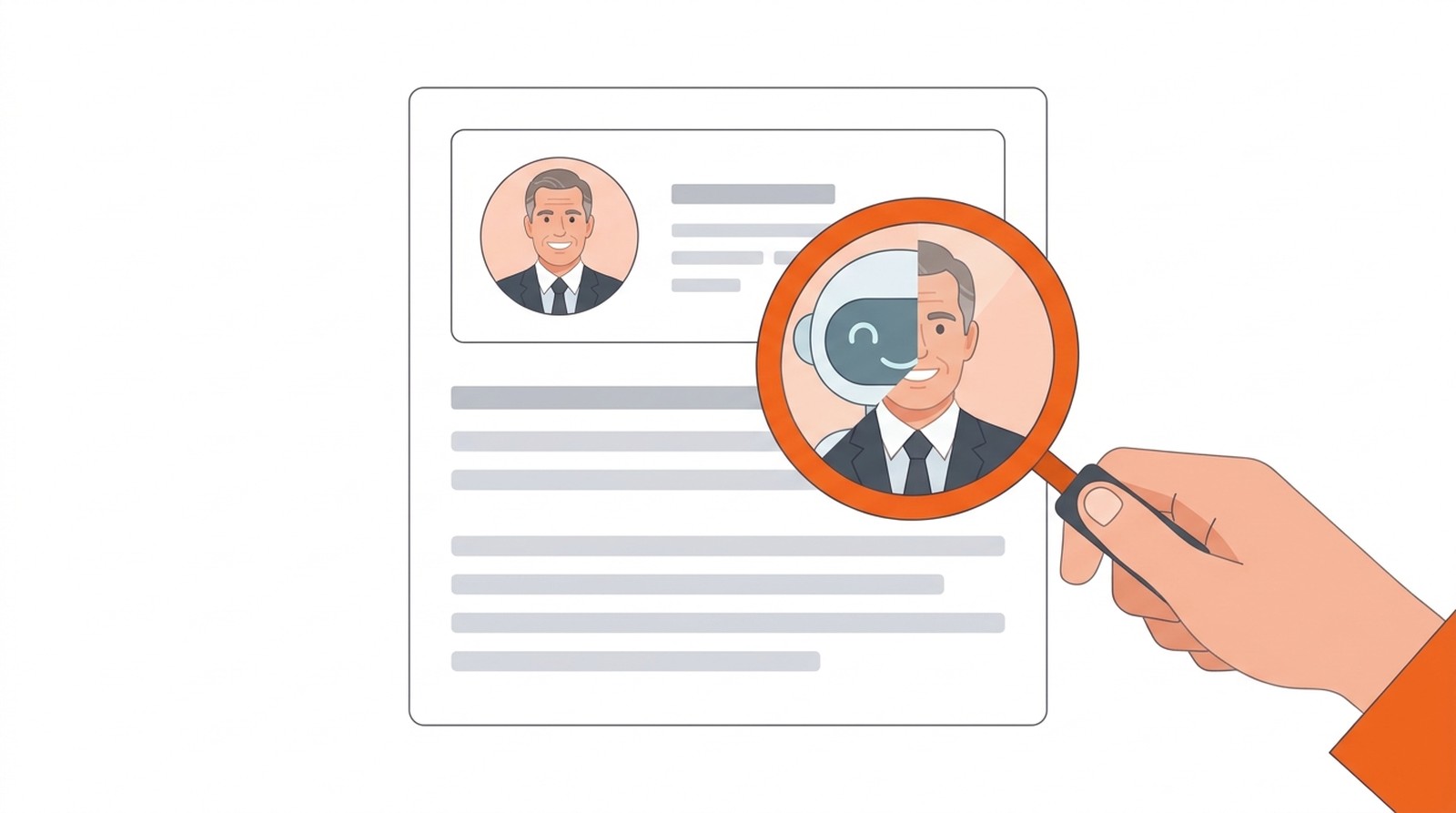
If you’re working out how to get NDIS clients, most guides hand you ten channels and treat them as equals: directories, posts, expos, ads, a referral program. They aren’t equal. For most providers, new enquiries start with someone the participant already trusts, and that person checks you in about a minute before deciding whether your name is worth passing on. The participant still chooses.
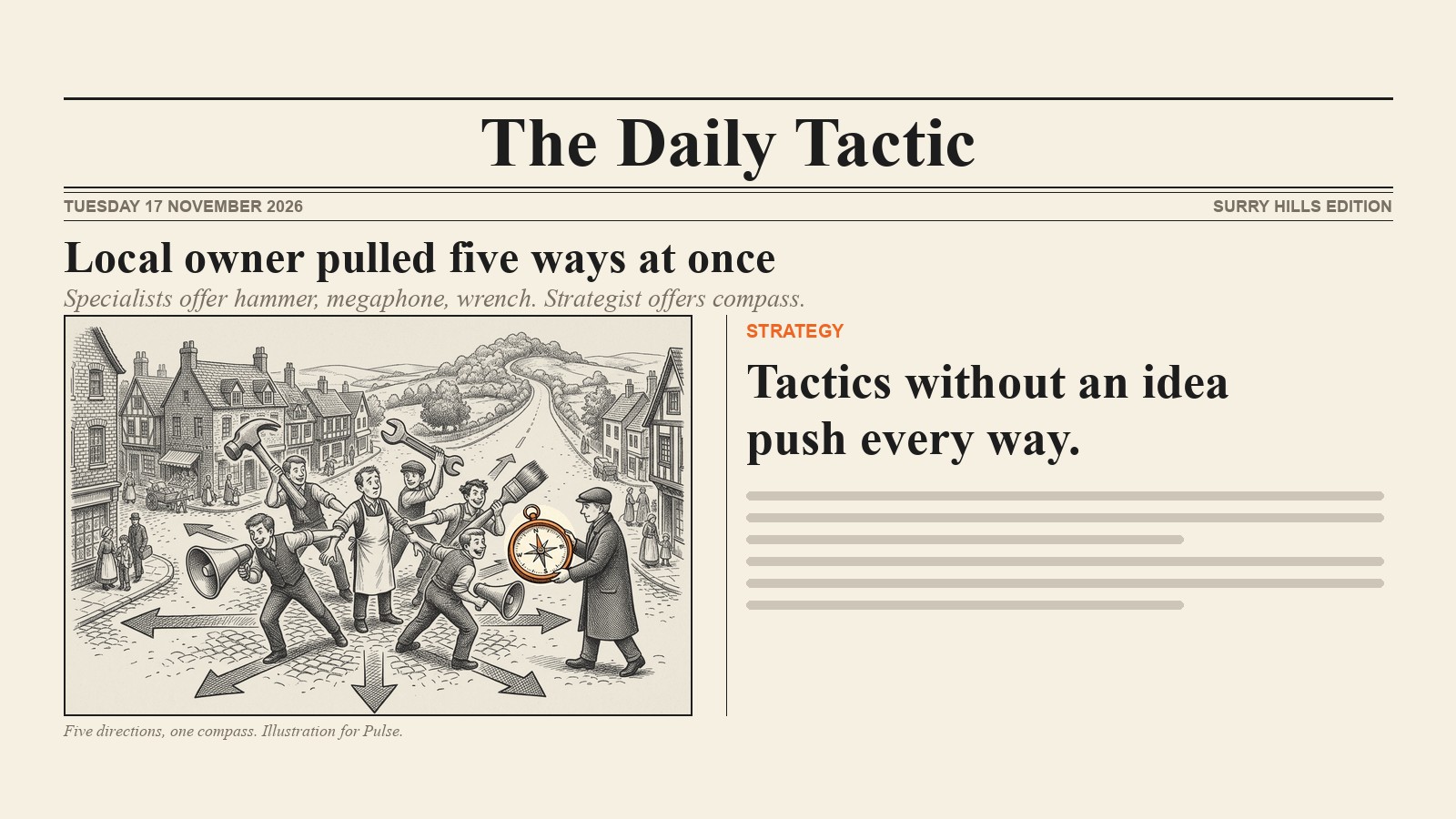
So this guide is about two jobs: being easy to refer, then easy to check. By the end you’ll know who sends participants to services like yours, what each of them looks at first, and what to hand them. I’m also going to tell you to bin one popular tip. Rewarding people for referrals stopped being a growth tactic on 20 November 2026 and became a legal risk.
For the wider picture (search, ads, content, brand), start with our page on marketing for NDIS providers. This piece sticks to referrals and the basics that support them.
Start with who is allowed to choose you
Before you market anything, check which participants can actually use you. NDIA-managed participants, whose funding the agency pays directly, can only use registered providers. Plan-managed and self-managed participants can also choose unregistered ones.
It sounds like admin, but it shapes everything else. An unregistered provider who doesn’t say so wastes a coordinator’s time, and coordinators remember. Put your registration status and the funding types you accept on your website, your referral sheet and every listing.
How to get NDIS clients from support coordinators: make referring a one-minute job
The NDIS says support coordinators help participants choose the right providers. They can’t put your name forward if they’d have to chase your capacity, suburbs and funding details first. On one page, or in one email, give them:
- your services, in plain English, not registration group codes
- the suburbs you cover
- your registration status and the funding types you accept
- current capacity, with a date on it
- how fast you reply to referrals
- a named person with a direct line
Don’t (example, a fictional community access provider in western Sydney): “Hi! We’re a passionate, person-centred provider offering a wide range of services across Sydney. Refer a client this month and receive a $50 gift card.”
Nothing there helps a coordinator decide, and the gift card is now an inducement risk (more below).
Do (example): “Capacity update as at [date]: weekday community access in [suburbs]. We’re [registered / not registered] and accept [plan-managed / self-managed / NDIA-managed] participants. We can take new participants from [date]. We reply to referrals within one business day. Call [name] on [direct number].”
Send it monthly, even when you’re full: “full until March” still shows you’re organised. Think of a property manager’s list of tradies. The plumber who answers, turns up and invoices cleanly stays on it. The one with the glossy van who never calls back quietly drops off.
Families, allied health, LACs and plan managers each check something different
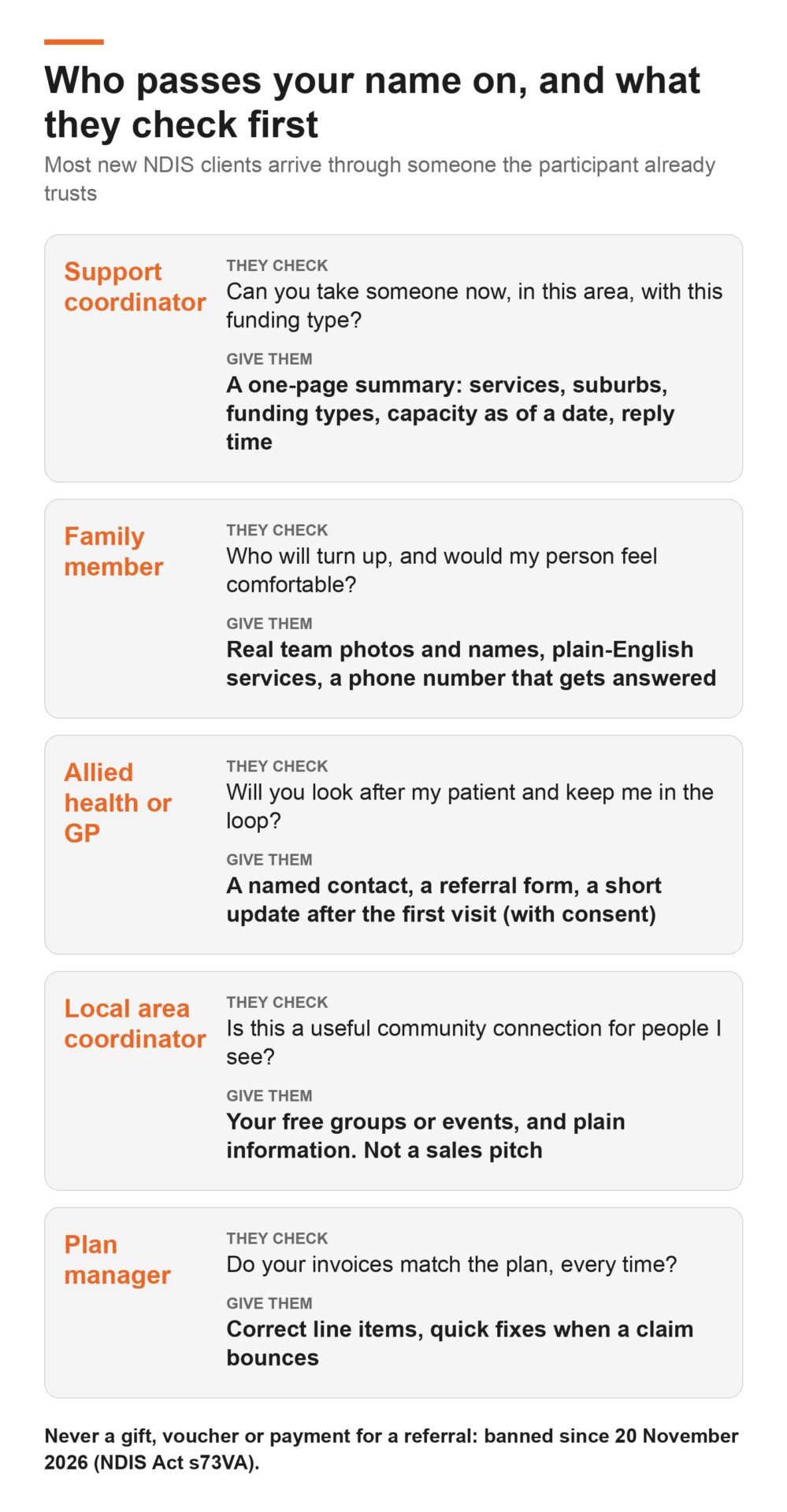
Families want to know their person will be treated well. Allied health professionals and GPs want a clear referral process and consent-based updates. LACs (local area coordinators) are NDIS partners from independent organisations who work with people aged 9 to 64. They don’t approve plans or allocate funding, so bring them community groups and open sessions, not a brochure. Plan managers must be registered, and they check claims and pay providers. To them, your reputation is your invoices.
| Who refers | What they check first | What to give them |
|---|---|---|
| Support coordinator | Services, suburbs, registration, funding types, capacity, reply speed | One-page referral sheet, monthly dated capacity update, named contact |
| Family member | Plain-English services, the workers, what happens next | A clear “what happens next” page and a phone answered by a person |
| Allied health or GP | Fit for the person, worker qualifications, how you report back | Short service summary, referral process, consent-based updates |
| LAC | Something useful for community connection | Details of groups, events and open sessions |
| Plan manager | Invoices that match the service agreement | Clean invoices and quick answers to claim queries |
NDIS directories: choose by who you are, not by the list
Most guides lump these together, but they do different jobs. Check the fit with your registration status, funding types and service before you pay:
- NDIS Provider Finder lists registered providers. If you’re unregistered, you won’t be there.
- MyCareSpace is a paid directory on a quarterly subscription that takes registered and unregistered providers. Credit where due, its own page says: “We cannot guarantee your success.”
- Clickability is a disability services directory with reviews.
- Mable is a platform for independent support workers, used with self-managed or plan-managed funding.
- Hireup is an NDIS-registered platform where participants find and book support workers.
The last two are built around individual workers, not organisations. If you run a therapy practice or a SIL service, they aren’t your directory; for an independent support worker, they might be the main one. Whatever you choose, judge each listing by the enquiries it actually sends, not by its traffic claims.
Your NDIS Google Business Profile: real name, honest address, genuine reviews
Google’s Business Profile guidelines are blunt: use your real-world business name, with no service or location keywords added. Service-area businesses, including providers who visit people at home, should hide their address, which matters if you run things from your kitchen table.
Don’t (fictional): “Bright Path NDIS Registered Provider Disability Support Parramatta”
Do: “Bright Path Community Care”, with services and suburbs in the fields built for them.
The NDIA’s logo guidelines also treat “NDIS” in a business, trading or domain name as implying an official link, and “registered” in a name can suggest a status you don’t hold. On reviews, follow the ACCC’s online review rules: no fake reviews, no deleting genuine negative ones. If you advertise a regulated health service such as physio, OT or psychology, Ahpra’s guidelines rule out testimonials in your advertising.
Your website is where every referral gets checked
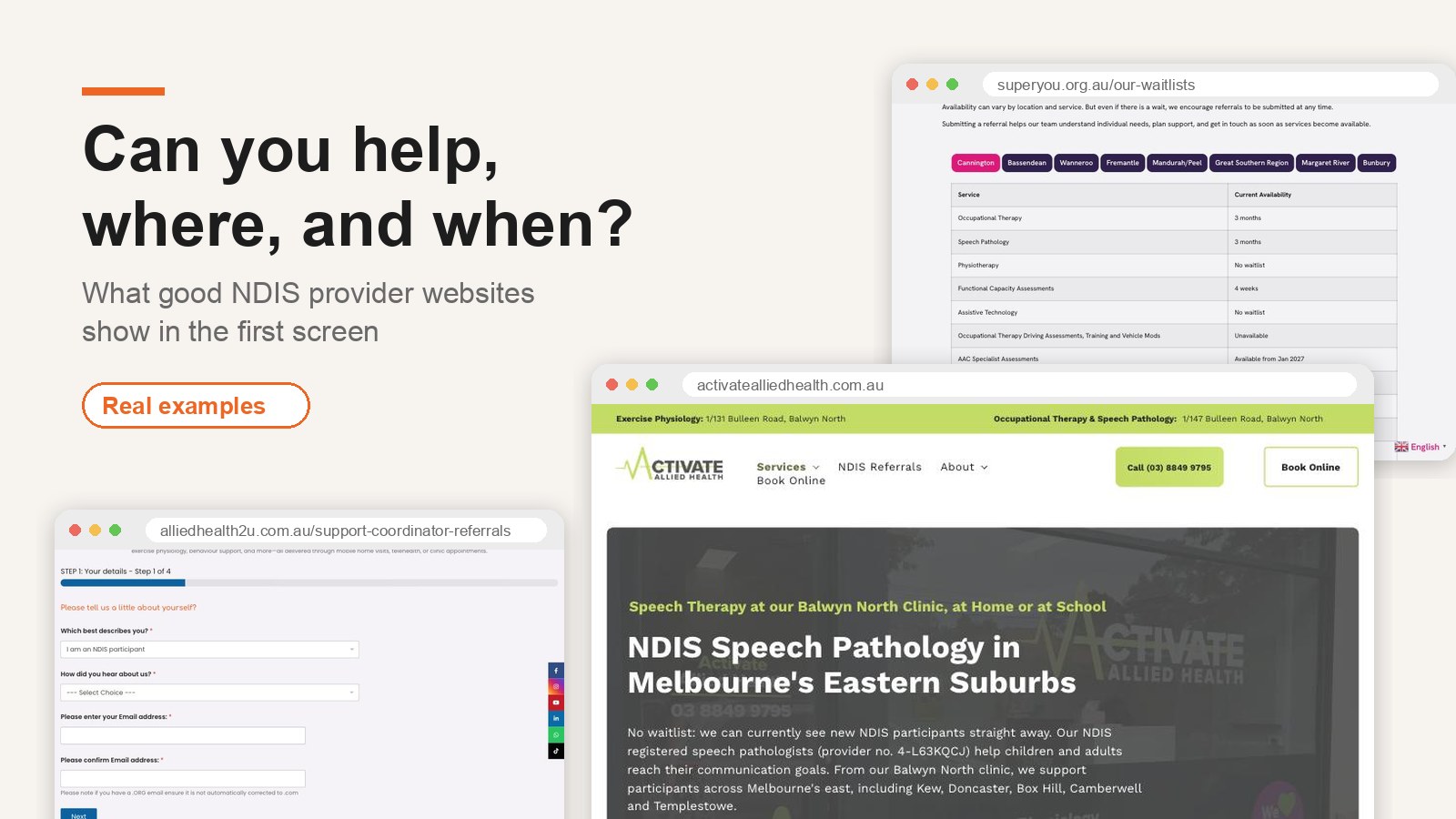
Every referrer ends up on your site, usually on a phone between two other calls. A lot of provider websites answer “who we are” and skip “can you help this person, here, and when?”
Don’t: “Empowering lives through person-centred care.”
Do: “Weekday community access and in-home support in [suburbs]. Taking new participants from [date].”
Show services, suburbs, registration, funding types, dated capacity, reply time and a referral contact. Our guide to NDIS website design has real provider examples and a checklist, and the piece on SEO for NDIS providers covers how families who search for themselves find you.
Referral rewards are now an inducement risk
This part is serious. Referrals themselves aren’t banned; the risk is giving or offering a benefit to win one. Section 73VA of the National Disability Insurance Scheme Act 2013 (the NDIS Act), inserted by the NDIS Amendment (Securing the NDIS for Future Generations) Act 2026, bans certain inducements from 20 November 2026. The Act says “it does not matter whether the person is the participant”, so a gift to a coordinator or a family member is covered too. The rules can never permit alcohol, illegal drugs, tobacco or e-cigarettes, cash or cash-like products, or electronic devices, and the offence carries up to two years’ imprisonment or 120 penalty units. A $50 gift card for a referral is exactly the kind of cash-like benefit to stop sending.
The NDIS Commission’s Code of Conduct guidance had already warned against gifts and referral arrangements that affect supports. Our post on what the NDIS inducement ban means for your marketing goes through what’s still allowed.
Fair counterpoint: relationships matter in this sector, and nobody wants a coffee catch-up treated as a crime. Build them on reliability and useful information, not gifts. If value changes hands, get legal advice first. This guide isn’t legal advice.
How to get NDIS clients you can plan around: track every source
You can’t tell whether coordinators, directories or search are pulling their weight until every enquiry is tagged at the source. Add a “how did you hear about us?” question to your form and phone script, record the referrer’s name in your CRM (customer relationship management system) and look at the numbers monthly.
When we worked with Auscare Support, every channel was tracked: search ads, phone calls, landing page forms and live chat. Over six months, form submissions rose 146%, call volume rose 689% and the client base doubled, as the Auscare Support case study sets out. Those results came from search, video, social and a new website, a reminder that families also go looking on their own. One provider’s result isn’t a forecast for yours. Tracking is how you’d know what’s working for you. If you want help setting that up, that’s what our lead generation work covers.
This week’s job: the one-minute test
Decide which referrer you’ll make life easier for first: the coordinator, the family, the allied health professional or the plan manager. Then build the sheet, the page and the tracking around that person. If it’s coordinators, pick the three you’d most like to work with and send them the one-pager this week. If you’d like a hand with referral-ready pages and tracking, talk to the Pulse team.
Frequently asked questions
How do I get NDIS clients as a new provider?
Start with who can choose you: NDIA-managed participants can only use registered providers, while plan-managed and self-managed participants can also use unregistered ones. Then make referring easy. Send support coordinators a dated capacity update and show your services, suburbs and funding types clearly online. Participants always choose, so no number of clients is guaranteed.
How do I find NDIS participants without paying for ads?
Focus on the people participants already trust: support coordinators, families, allied health professionals and local area coordinators. Give each one what they need to refer you, such as a one-page summary or details of community groups. Choose directories that suit your registration status and track where every enquiry comes from.
How do I get referrals from NDIS support coordinators?
Make referring you a one-minute job. Send a short email with your services in plain English, suburbs, registration status, funding types, dated capacity, reply time and a named contact. Send it monthly, even when you’re full. Coordinators help participants choose providers, but the participant always makes the final decision.
Do I need to be registered to get NDIS clients?
Not for every participant. NDIA-managed participants must use registered providers, while plan-managed and self-managed participants can also choose unregistered ones. Unregistered providers won’t appear on the NDIS Provider Finder. Be upfront about your status on your website, referral sheet and listings, so referrers don’t waste time on a mismatch.
Can I offer a gift or reward for NDIS referrals?
Treat it as a serious legal risk. Since 20 November 2026, section 73VA of the NDIS Act has banned inducements likely to influence who someone engages, even when the person isn’t the participant. Cash, cash-like products, devices, alcohol and tobacco can never be permitted, and the offence carries up to two years’ imprisonment. Get legal advice first.