
Marketing for tradies starts with the jobs you’re already losing
Most marketing for tradies starts with buying more leads. Start with the calls, quotes and follow-ups you're already losing, then build Google Business Profile, reviews, service pages and Google Ads, all judged on cost per booked job.
Most marketing for tradies starts in the wrong place: buying more leads. Before you pay for another click, fix the calls, quotes and follow-ups you’re already losing. Below: what to fix this week, what to build next, and the one number that shows whether any of it works.
It’s not the order most people will sell you. Most tradie marketing advice is more SEO, more ads, another lead site. I start with the jobs slipping away while you’re half under a sink, because they’re the cheapest jobs you’ll ever win.
The fairest pushback: if your phone genuinely never rings, plugging gaps won’t create demand. But every new lead you buy still runs through the same pipe, so fix the pipe first. It’s the same order behind how I approach marketing for trades and property services.
Tradie marketing starts with the leaks, not more leads
You don’t turn up the water pressure on a pipe that leaks at every joint. Buying extra leads while calls go unanswered and quotes go out late is exactly that. Fix the joints first: they’re cheap, and you’ve already paid for every enquiry that drips through.
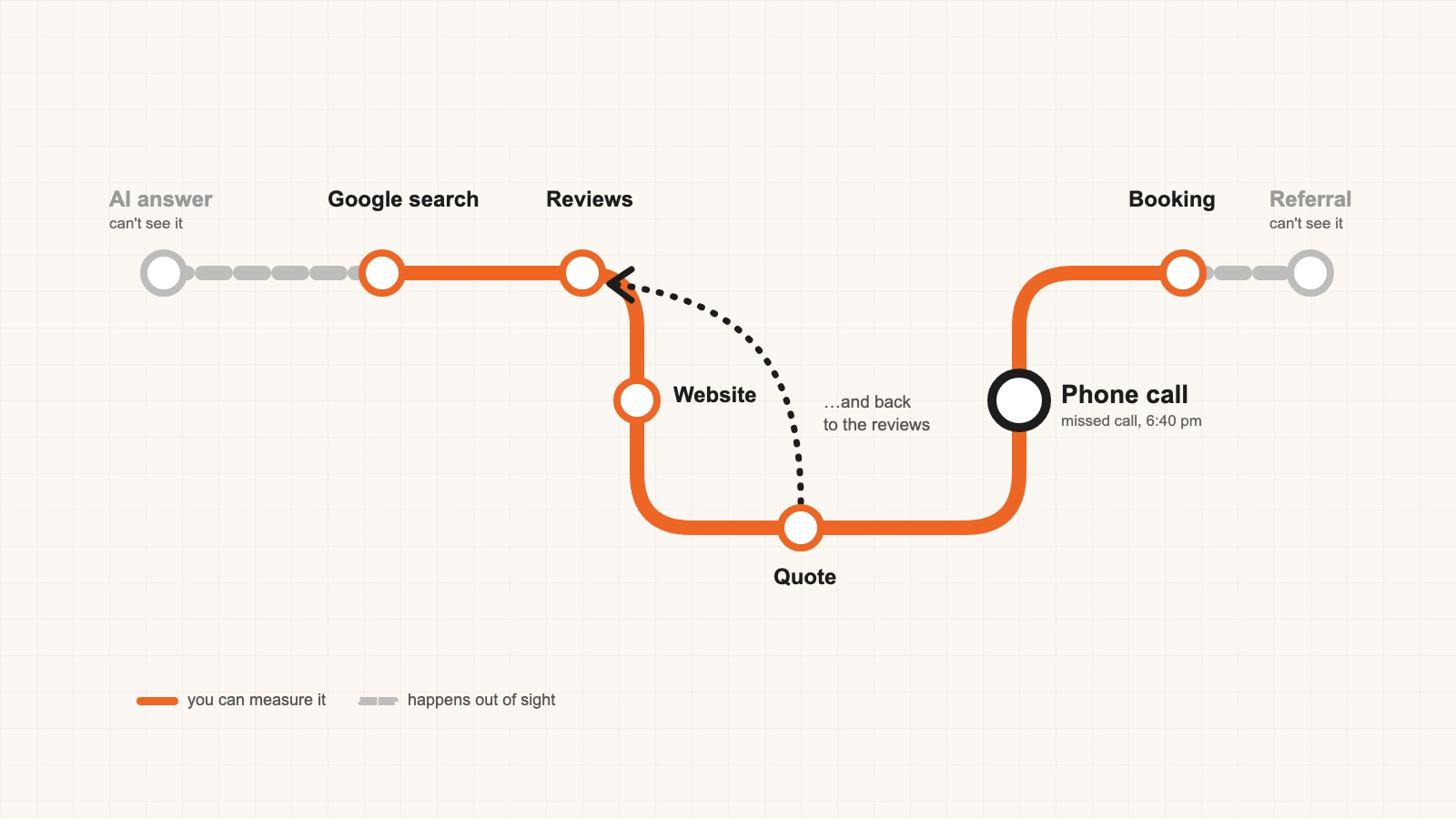
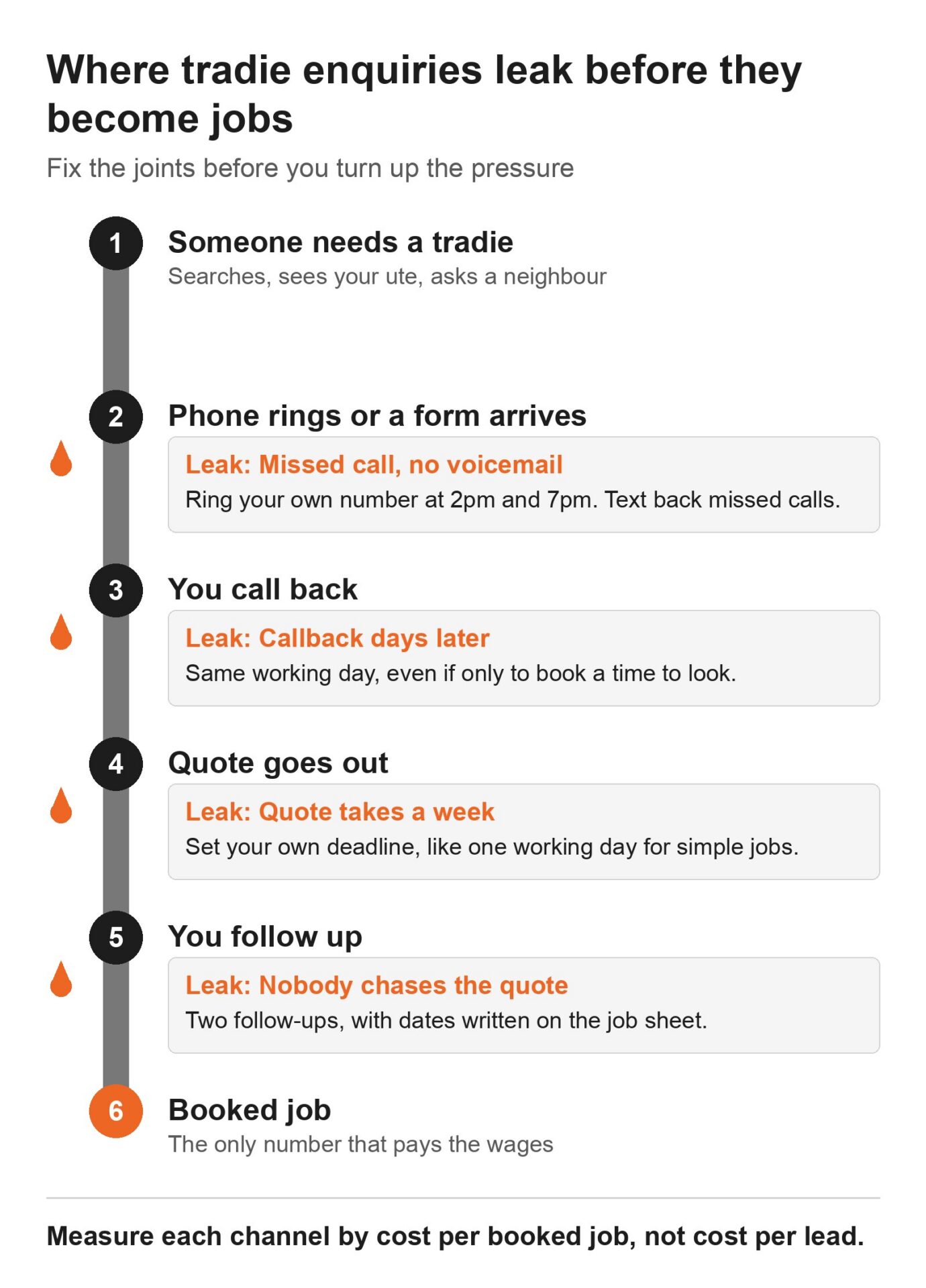
There are four joints: missed calls, slow quotes, no follow-up, and no record of where the work came from. All boring, all costing you work.
Ring yourself at 2pm and 7pm
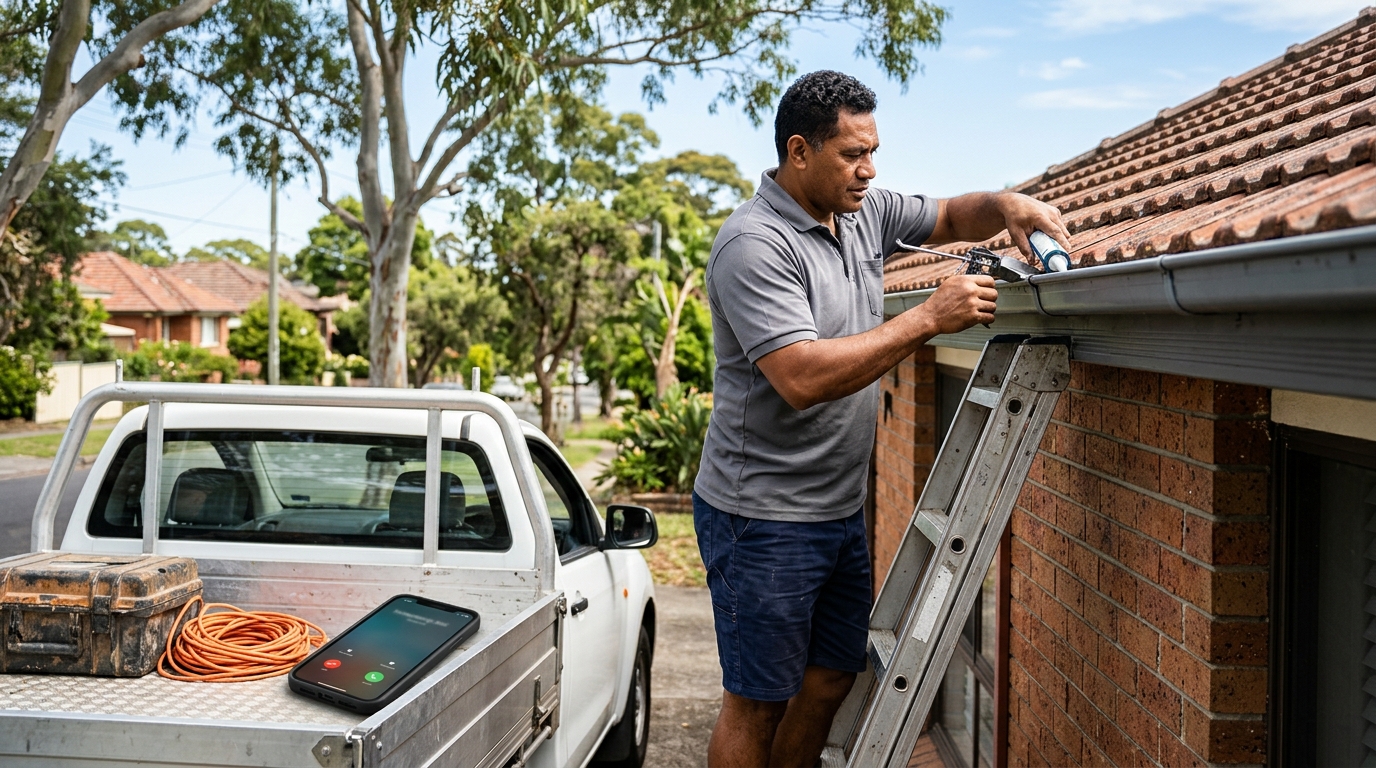
Call your own number on a weekday at 2pm, when you’re on the tools, and at 7pm, after knock-off. Hear what a customer hears.
Record a greeting that says who you are and when you’ll call back. If your phone system offers a missed-call text back, keep it about their enquiry: “Sorry I missed you, I’m on a job, I’ll ring back by 5.” Anything promotional is a different matter (more on that below).
Quote within one working day
That’s my standard, not a statistic. No study I can point to proves the first quote wins, but a homeowner with a leaking roof is ringing around, and a quote that lands three days later is competing with people who’ve already turned up.
Follow up every quote twice
My rhythm: a couple of working days after the quote, then about a week later. Diary the dates the day you send it, not in your head in the ute. A quote nobody chases is a quote you’ve decided to lose.
Keep a job sheet with four columns
Enquiry, source, quoted, booked. A spreadsheet works; so does a notebook on the dash. It’s what makes the last step in this guide possible.
Your Google Business Profile will do more for you than a new logo
A rebrand feels like progress. A properly set-up Google Business Profile, the free listing in Maps and local results, usually does more, and plenty are half finished.
- Primary category: pick the one that matches the work you want most.
- Address and service areas: if customers don’t come to you, remove the address. Google’s service area help page allows up to 20 areas, within about two hours’ drive of your base.
- Name: Google’s profile guidelines ask for your real-world business name.
- Photos: real jobs, not stock images.
Google’s own page on local ranking says results come mainly from relevance, distance and popularity. It also says there’s no way to request or pay for a better local ranking. So “guaranteed number one on Maps” is a promise Google says nobody can make.
Don’t: “Dave’s Plumbing | Emergency Plumber Sydney 24/7 Cheap”. Do: “Dave’s Plumbing”, the name on the van and the invoices. Dave is made up. His keyword stuffing is all too real.
Reviews are where it gets serious. Ask every customer, the same way, at handover. business.gov.au says asking is fine; if you follow up by email or text, make sure you have the customer’s permission. Never offer a discount or freebie: Google’s Maps policy bans any incentive. The ACCC says fake or misleading reviews are illegal, and rewarding positive ones risks breaching the law. The rest of the profile work is in my local SEO checklist.
SEO for tradies means one strong page per service, not one per suburb
The usual move is dozens of near-identical suburb pages. I’d rather see one solid page per service you want to sell.
Suburb pages earn their place when you have something real to say: a job there, photos, local quirks. Otherwise they look a lot like what Google’s spam policies call doorway abuse. That’s pages made to rank for similar searches that aren’t as useful as the final destination.
Some suburb pages do rank, to be fair. They rarely convince a homeowner, and they put the site at risk. Picture a sparky in Randwick. Don’t: “Electrician Bondi”, “Electrician Coogee”, “Electrician Randwick”, the same few paragraphs with the suburb swapped. Do: one switchboard upgrades page with real photos and what the job involves. Add a Randwick page once there’s a real job to show, like an older terrace with tricky access. That’s the kind of page I’d build first if you asked us for help with SEO.
Google Ads for tradies only pays when someone answers the phone
Ads amplify whatever’s behind them. With the leaks open, you’re paying to lose calls faster.
- Search campaigns first: the text ads that show when someone searches. Start with your best-margin services.
- Location set to “Presence”: Google’s location options let you target people in, or regularly in, your area, not people merely interested in it.
- Call assets, scheduled: your phone number shown with the ad. No call button at 9pm if the phone goes to voicemail. Google lets you schedule them for hours you answer, and with call reporting turned on, calls can count as conversions. A tap on the call button is charged like any other click (your cost per click, set by the ad auction).
- Website calls: a Google forwarding number counts calls from your site too.
- The matching service page: each ad goes to that service’s page, not the homepage.
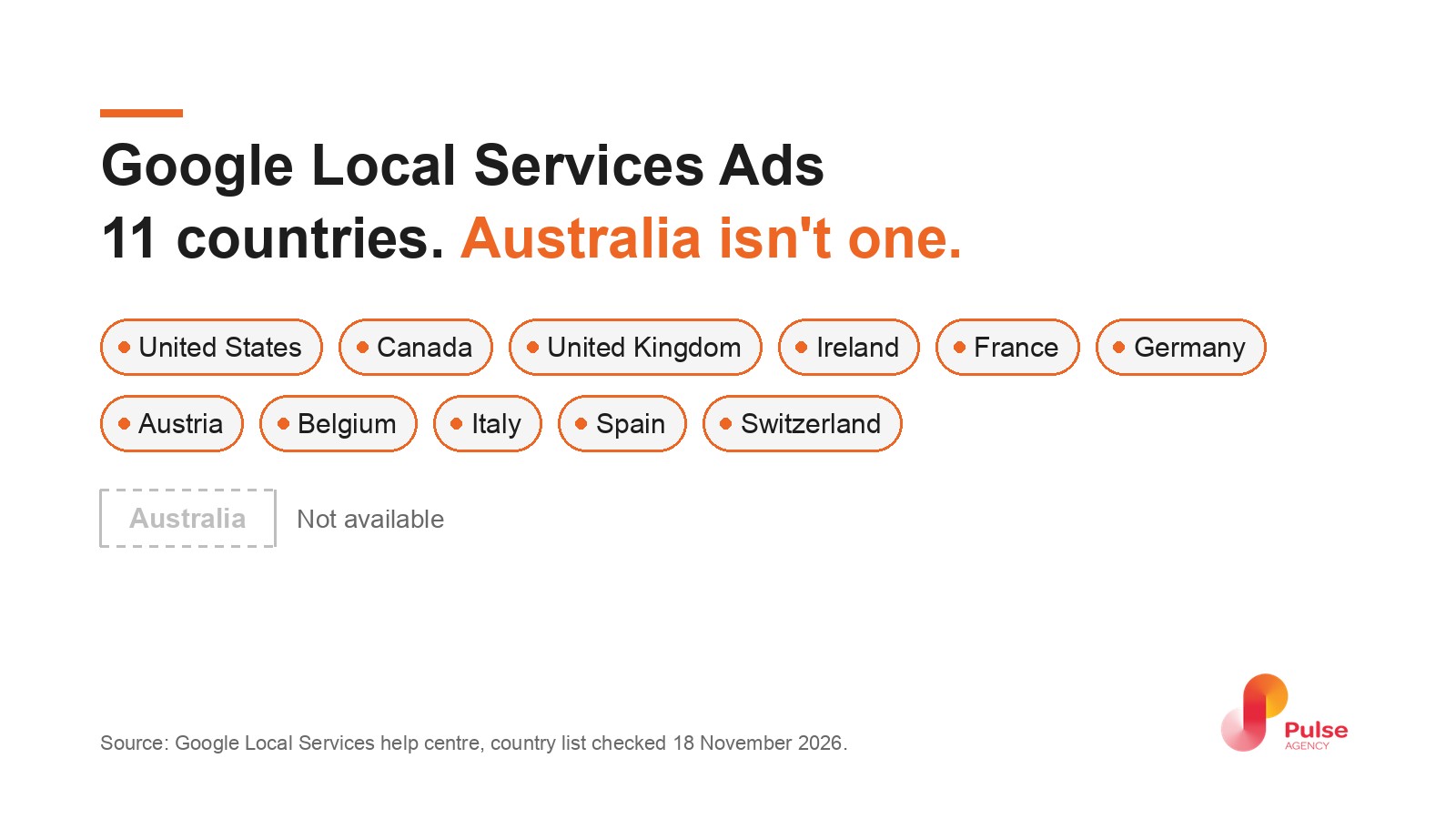
Local Services Ads aren’t available in Australia. And Google is phasing out call-only ads (they stop serving in February 2027), so build on call assets. Budget depends on your area, your services, competition and how many calls you can actually handle. That’s the first conversation in any Google Ads management we take on.
Where the click lands matters as much as the ad. We saw that with Ocean Glass, a glass pool fencing business on the Northern Beaches, in a three-month Google Ads test with one ad group per service. In April 2022 the same pool fencing ads converted at 8.15% on the pool fencing page (19 conversions) and 4.26% on the homepage (8 conversions). Qualified leads rose 30% in the first month, and the conversion rate rose 109% over the three months (the Ocean Glass case study has the detail).
Conversion rate is the share of people who clicked and then got in touch: roughly eight per 100 clicks instead of four, from the same ads. The caveat: the April numbers are small, an early signal, and they count enquiries, not booked jobs.
Job photos and referrals are marketing you’ve already paid for
Every finished job is content and a possible referral. Take a before and after, with the customer’s OK, for your profile and service pages.
Ask for a referral at handover, the same moment you ask for the review. Then get permission before texting or emailing anyone afterwards. Under the Spam Act, ACMA says marketing messages need consent, must identify you and must make unsubscribing easy.
Your licence number belongs on every ad, including the ute
This is general information, not legal advice, so check with your own regulator. It’s also the easiest step to forget.
In NSW, Fair Trading says all building ads, whether print, internet, TV or radio, must show the licensee’s name, licence number with the correct category of work, and business phone.
The same page says you can’t advertise residential building work over $5,000 without a contractor licence, or specialist work of any value (electrical wiring, plumbing, draining, gasfitting, air conditioning and refrigeration).
In Queensland, the QBCC wants your name and licence number in ads. Its list covers websites, social media pages, directories like Gumtree, hipages and ServiceSeeking, flyers, business cards and vehicle signage. Yes, the ute is an ad. Elsewhere, check your regulator before the next print run.
Marketing for tradies comes down to one number: cost per booked job
Enquiries feel good; booked jobs pay the bills. Cost per booked job is what you spent on a channel in a month, divided by the jobs actually booked from it. With the source column filled in, you can compare ads, your profile, lead sites and referrals on equal terms.
Lead sites can fill a quiet patch; judge them on booked jobs like everything else. Call tracking keeps the source column honest; otherwise every phone enquiry gets put down to “Google, probably”.
Run the ring-yourself test this arvo. Then pull out last month’s quotes and count how many you chased twice. How many of those quotes are still sitting there? If you’d rather someone set up the ads or search side once the leaks are fixed, talk to us.
FAQ
What is the best marketing for tradies?
The best marketing is whatever books jobs at a cost you’re comfortable with. For most trade businesses, that starts with answering every call, quoting fast and following up. Then build your Google Business Profile, reviews and one page per service, and judge each channel on booked jobs.
How do I get more clients as a tradie?
Start by winning more of the enquiries you already get. Return missed calls quickly, quote within a working day and follow up every quote twice. Then grow through your Google Business Profile, reviews, service pages and, once calls are reliably answered, search ads aimed at your area.
Is SEO or Google Ads better for tradies?
They do different jobs. Google Ads can put you in front of searchers quickly, but you pay for every click and call. SEO takes longer, yet strong service pages keep working without a per-click cost. A sensible approach is running ads while SEO builds, then comparing both on cost per booked job.
What’s the cheapest way to advertise a trade business?
The cheapest jobs come from enquiries you already receive, so fix missed calls and slow quotes first. After that, a complete Google Business Profile costs only time, as does asking every customer for an honest review. Job photos and referral requests are free too, provided you get consent before marketing messages.
Do I need my licence number on my ads and website?
In NSW and Queensland, generally yes. NSW Fair Trading requires building ads to show the licensee’s name, licence number and business phone. The QBCC requires your name and licence number, and treats websites, social media, directories and vehicle signage as ads. Elsewhere, check your regulator. This is general information, not legal advice.