Why Most NDIS Providers Look Identical — And How To Stand Out In A Commoditised Market
In 2019, Max King looked at his competitors’ Facebook ads and realised something that most NDIS providers still haven’t figured out: everyone was invisible because everyone looked identical. Stock photos of people in wheelchairs smiling at carers. Generic copy about “empowering independence.” The same blue and green colour schemes. Auscare Support’s CEO knew that his […]
In 2019, Max King looked at his competitors’ Facebook ads and realised something that most NDIS providers still haven’t figured out: everyone was invisible because everyone looked identical. Stock photos of people in wheelchairs smiling at carers. Generic copy about “empowering independence.” The same blue and green colour schemes. Auscare Support’s CEO knew that his NDIS provider marketing strategy needed a completely different voice — not just a different platform.
Fast-forward six months after changing their messaging approach, and phone calls to Auscare Support increased by 688%. Form submissions jumped 146%. They doubled their client base. The secret wasn’t better targeting or a bigger ad budget — it was finally having something worth saying in a market where everyone else sounds exactly the same.
Table of Contents
Why Every NDIS Provider Ad Looks Like A Government Brochure
273,673 active NDIS providers — NDIS National Dashboard, 2025
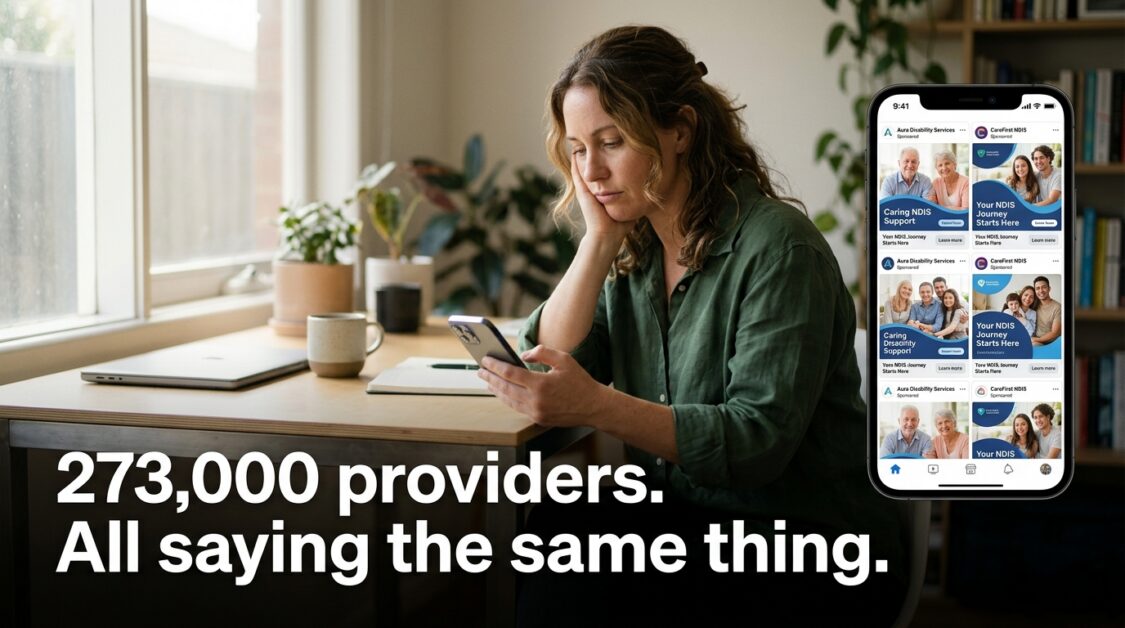
That’s how many registered providers are competing for the same participants right now. And here’s the kicker — scroll through Facebook or Google search results and try to tell them apart. You can’t. They’re all using the same stock photos, the same buzzwords, the same compliance-safe messaging that says absolutely nothing.
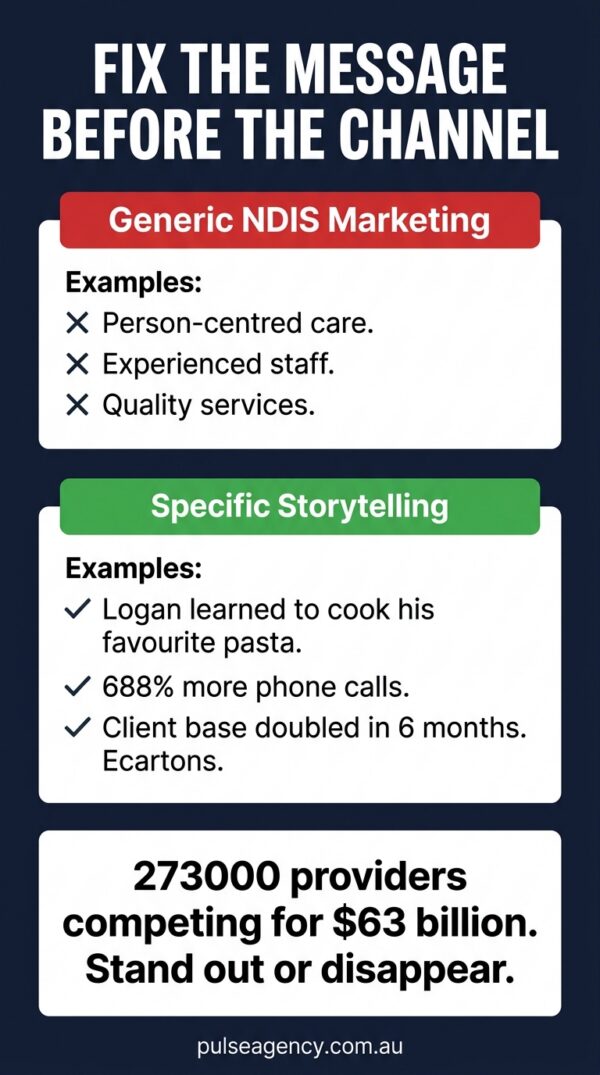
“Quality person-centred care.” “Empowering your journey to independence.” “Flexible support solutions.” When every provider uses these exact phrases, they become meaningless noise. It’s like having 273,673 people at a party all shouting “Hello” at the same volume — nobody gets heard.
The commoditisation trap works like this: providers see what their competitors are doing, assume it must work, and copy it. Soon everyone’s website could have logos swapped and nobody would notice the difference. The irony? They’re all trying to look professional and trustworthy, but end up looking forgettable instead.
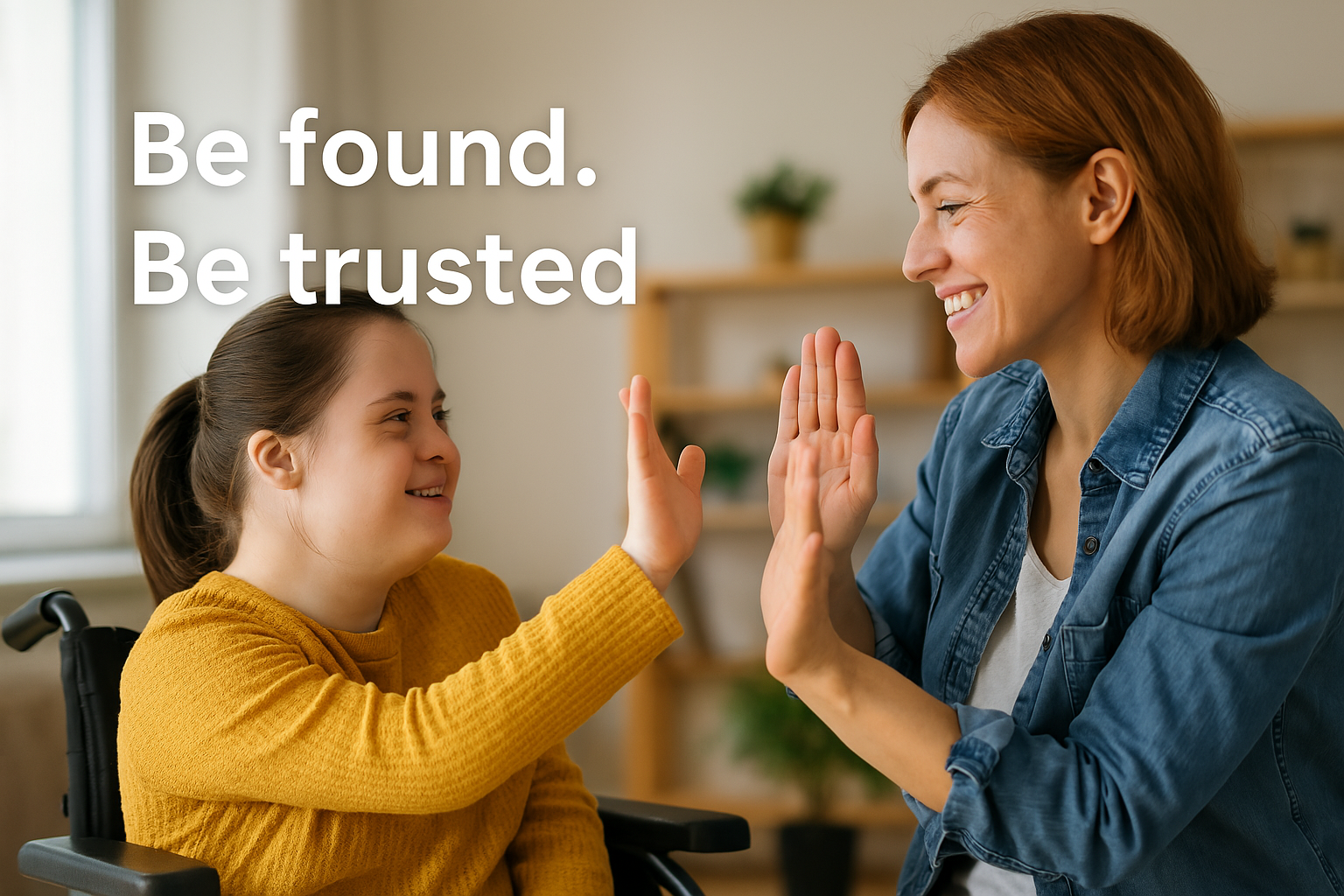
Stock photos make this worse. Generic images of diverse people in wheelchairs with beaming carers might tick compliance boxes, but they don’t tell anyone why they should choose you over provider number 184,522. Real participants have names, goals, and specific outcomes. Stock photos have release forms.
“When you’re afraid to sound different, you guarantee you’ll sound invisible.” — Nicolás Pustilnick
The Channel Obsession That Misses The Point
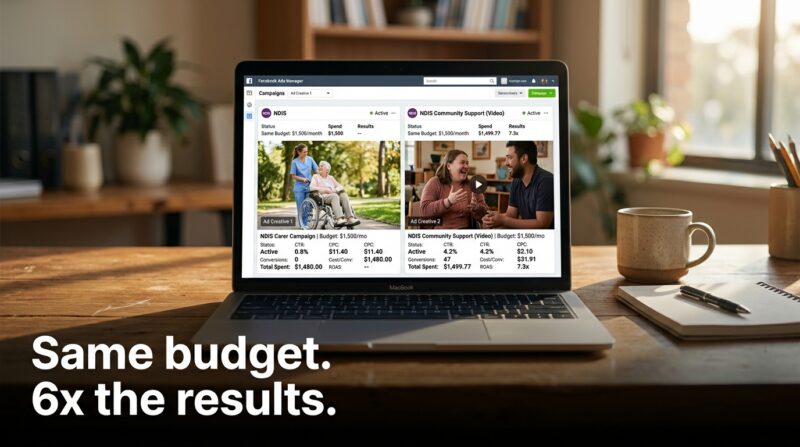
Most NDIS providers obsess over the wrong question: “Should we be on Facebook or Google?” They compare click-through rates, debate organic reach versus paid ads, and wonder if they need TikTok. Meanwhile, their messaging problem goes unfixed.
Here’s what actually happens when you have generic messaging across multiple channels: you fail everywhere simultaneously. Facebook ads that actually convert need compelling content, not just better targeting. Google Ads with boring headlines get ignored regardless of keyword match types. SEO content that sounds like everyone else’s won’t earn links or engagement.
Auscare Support wasn’t failing because they were on the wrong platforms. They were failing because their message — like every other provider’s — was forgettable. Max King’s breakthrough came when he stopped focusing on where to advertise and started focusing on what to say.
The data backs this up. Their original generic campaigns were generating enquiries, but from price shoppers and time-wasters. People who called multiple providers asking “How much do you charge?” without understanding the service. After switching to story-driven messaging, enquiry quality improved dramatically. Real participants with genuine needs started calling.
How Auscare Support Broke The Mould With Real Stories
Max King’s realisation was simple but radical: people don’t buy NDIS services — they buy outcomes. So instead of talking about “quality care,” Auscare started talking about Logan getting his first job at 23 and Belinda finally moving to her own place.
The breakthrough campaign featured video content that tells real stories of actual participants. Not actors. Not testimonials read by voiceover artists. Real people with real names talking about specific achievements.
Logan wasn’t described as “a client who achieved independence.” He was Logan, who worked with Auscare to build confidence, practice job interviews, and land his first role at a local café. Belinda wasn’t “a successful outcome.” She was Belinda, who wanted her own space and worked with support workers to find a suitable unit and learn independent living skills.
- Form submissions increased 146.15%
- Phone calls jumped 688.89%
- Client base doubled in six months
- Enquiry quality improved — fewer price shoppers, more qualified participants
“I have worked with Nico and his team over 5 years and would be LOST without him.” — Max King, CEO Auscare Support
The Three Elements Every Standout NDIS Provider Needs For Marketing Differentiation

Auscare’s success wasn’t luck. It followed a pattern that any provider can replicate, but most won’t because it requires doing three uncomfortable things that feel risky.
Specific Participant Outcomes, Not Generic Benefits
Stop saying you provide “person-centred care” — every provider claims this. Start saying what person-centred care actually achieved for specific individuals. “Sarah learned to catch public transport independently after six months of travel training” tells a better story than “We provide community access support.”
Named Stories Over Anonymous Testimonials
Anonymous testimonials feel fake even when they’re real. “John S.” or “Happy Client” doesn’t build trust — it suggests you can’t find anyone willing to put their name to your work. Real people with real names create real connections.
Clear Point Of View On What Good Support Actually Looks Like
Every NDIS provider needs to answer this question: what do you believe about disability support that your competitors don’t? Auscare believes in showcasing participant achievements publicly rather than hiding behind anonymous case studies. What’s your equivalent stance?
What To Do First Thing Monday Morning
The Content Audit That Reveals If You Sound Like Everyone Else
Take your current website copy and remove your logo. Show it to someone unfamiliar with your business and ask them to guess which provider it represents. If they can’t distinguish it from your competitors’ sites, you have a messaging problem, not a marketing problem.
Three Questions That Uncover Your Differentiation Story
- What specific thing can you do now that you couldn’t do before working with us?
- What surprised you most about our approach compared to other providers?
- If you had to tell a friend why they should choose us, what would you say?
How To Test New Messaging Without Losing Compliant Copy
Conversion optimisation isn’t just about button colours and form layouts — it’s about testing whether interesting beats boring. Most NDIS providers never test this because they assume compliance requires blandness. It doesn’t.
“The biggest risk in NDIS marketing isn’t saying something wrong — it’s saying nothing memorable at all.” — Nicolás Pustilnick
Your next step is simple: find one participant willing to share their story with their real name and specific achievement. Create one piece of content about them this week. Test it against your current generic messaging and watch what happens to enquiry quality. That’s how you start standing out in a market of 273,673 identical voices — and winning at NDIS marketing differentiation.
Frequently Asked Questions
How many NDIS providers are there in Australia?
As of September 2025, there are 273,673 active NDIS providers registered across Australia, managing $63.491 billion in total annualised plan budgets according to the NDIS National Dashboard.
Why do most NDIS provider marketing campaigns fail?
Most campaigns fail because providers use identical messaging and generic stock photos rather than telling specific stories about real participants and outcomes. The issue isn’t the platform choice but the lack of differentiation in a commoditised market.
What’s the best marketing strategy for NDIS providers?
Focus on real participant stories with specific names and outcomes rather than generic compliance-safe messaging. Auscare Support increased phone calls by 688% by featuring participants Logan and Belinda instead of anonymous stock photos and generic testimonials.