
Strategy vs tactics: most marketing ‘strategies’ are just a to-do list
Most marketing 'strategies' are a to-do list of channels. A strategy is one idea that organises everything and pushes the business forward. Here's how to tell the difference.
Too many digital agencies sell a to-do list and call it a marketing strategy. That’s the whole strategy vs tactics problem in one line. Publish two blogs a month. Fix the site speed. Run Performance Max, Google’s automated campaign type. Post on Instagram three times a week. Useful things, maybe. But none of them is a strategy.
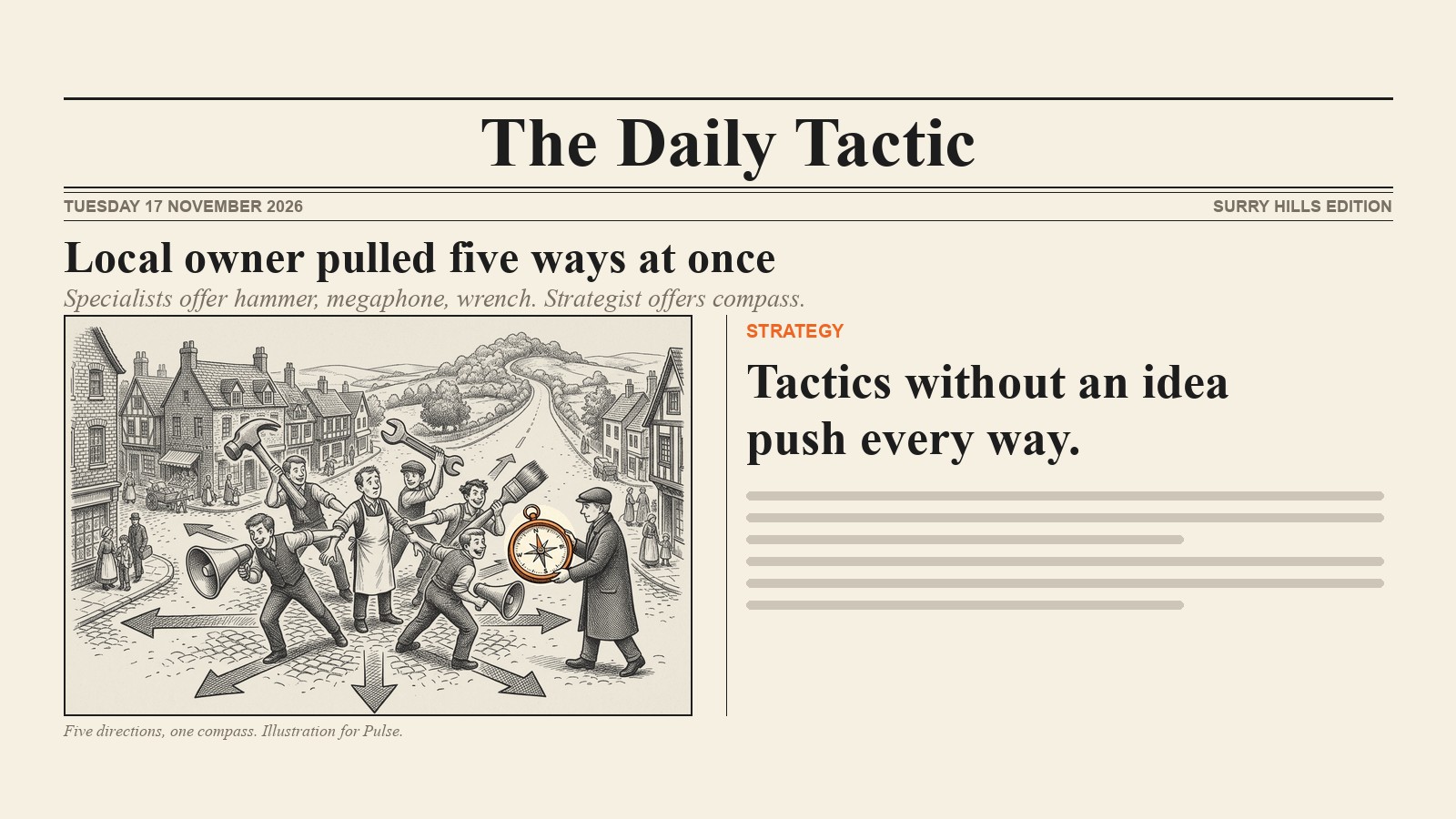
Here’s how I see it: a strategy is one idea that organises everything else and pushes the business forward. Tactics are what you do to push in that direction. When the idea is missing, every tactic pushes a different way, and you end up busy, spending money, and standing still.
I run a digital agency, so I’m criticising my own industry here, and sometimes myself. Strategy vs tactics sounds like a textbook debate. For a small business it’s the difference between a marketing budget that compounds and one that just leaks.
Strategy vs tactics: plenty of definitions, one idea
Strategy has more definitions than marketing has acronyms. These are the ones I find most useful:
- Michael Porter, in his 1996 Harvard Business Review essay “What Is Strategy?”: the essence of strategy is choosing what not to do.
- Richard Rumelt: a diagnosis of what’s going on, a guiding policy, and coherent actions that support each other.
- Roger Martin, in Playing to Win with A.G. Lafley: an integrated set of choices about where to play and how to win.
- Mark Ritson, who teaches the Mini MBA in Marketing: “diagnosis informs strategy, strategy directs tactics.” He coined a word for what happens when marketers skip the first two: tactification.
They don’t use the same words, but they agree on the important bit: strategy is a choice, and tactics come after it. My own version is shorter. A strategy is one idea that organises everything and pushes the business forward.
Mark Ritson · Marketing Week columnist, Mini MBA
Diagnosis first, strategy second, tactics last. There’s no such thing as a “digital strategy”, only a brand strategy that digital channels help deliver.
Ritson explains it himself in four minutes, for the Australian Marketing Institute:
The strategy is the choice: who you’re for, what you’ll be known for, what you won’t do. The tactics are the moves that make that choice real: the channels, the campaigns, the pages, the posts. Swap the order and you’re building a roof with no walls under it.
What the animation shows: three blocks stack in order: diagnosis at the bottom, strategy in the middle, tactics on top. Then the order is reversed and the tactics block is dropped in first with nothing under it. It wobbles and falls. Rebuilt the right way round, the stack holds.
Why digital marketing sells tactics as strategy
Too often, what arrives under the heading “SEO strategy” is this: a keyword list, a technical audit, a content calendar. Ask for a “social media strategy” and you’ll get posting frequencies and hashtags. These are plans for a channel. Ritson puts it bluntly: “you cannot have a ‘digital strategy’ or a ‘media strategy'”. You have one strategy, and channels serve it.
Rand Fishkin, who co-founded Moz, one of the best-known SEO software companies, makes the same point from inside search. In a SparkToro whiteboard on why the worst search marketers start content strategy with SEO keywords, he argues content strategy should be “business-goal centric, not search centric”. Keyword research comes after you’ve decided search is one of the places your audience pays attention, not before.

Rand Fishkin · co-founder of SparkToro and Moz
Start from the business goal and where your audience actually pays attention. Keywords come later, if search is one of your channels at all.
Photo: Sam Barnes / Web Summit, CC BY 2.0, adapted by Pulse.
I once saw the extreme version of this at a search marketing conference. A speaker from the US walked the room through his lead machine: cheap ads offering an Amazon gift card to anyone who’d fill in a form about SEO services. He showed the spend and the revenue, hundreds of thousands of dollars, with total confidence. Then he showed what people saw once they’d filled in the form: a generic, forgettable video explaining his value proposition. It could have been any agency’s.
The room applauded. When it was my turn, I congratulated him on the numbers and asked why he didn’t put that money and effort into positioning instead: working out what genuinely made his offer different, and making a video that showed it. He didn’t love the question. His answer, more or less: he was very successful, and what had I done? Fair point, I suppose, if the only scoreboard is revenue. A fair chunk of the room didn’t love the question either.
That moment stuck with me. In some corners of digital marketing, anything goes for a lead: pay for the click, fill the funnel, sort it out later. It’s tactics with no idea behind them, and it’s a big part of why our industry has the reputation it has.
Part of the problem is how our industry is built. Agencies hire specialists: an SEO person, a Google Ads person, a social person, a developer. Each is genuinely good at their craft. But the law of the instrument kicks in. Abraham Maslow put it best in 1966: if the only tool you have is a hammer, you treat everything as if it were a nail.
What the animation shows: a business owner holds up a sign: “Sales are flat.” Four specialists with hammers labelled SEO, Google Ads, Social and Web dev each bang out their answer: more keywords, more ads, post every day, a new website. Then someone without a hammer asks: why are sales flat? Who stopped buying? What makes you different? The hammers slowly come down.
None of those four answers is wrong, by the way. Any of them might be right. The point is that nobody asked what was going on before reaching for the tool.
Start with what’s going on
The questions that come before tactics aren’t new. In 1974 Stephen King, the strategist at J. Walter Thompson London who helped invent account planning (not the novelist), set out his planning cycle in the JWT Planning Guide. As Martin Weigel describes it, it runs on five questions: Where are we? Why are we there? Where could we be? How could we get there? Are we getting there?
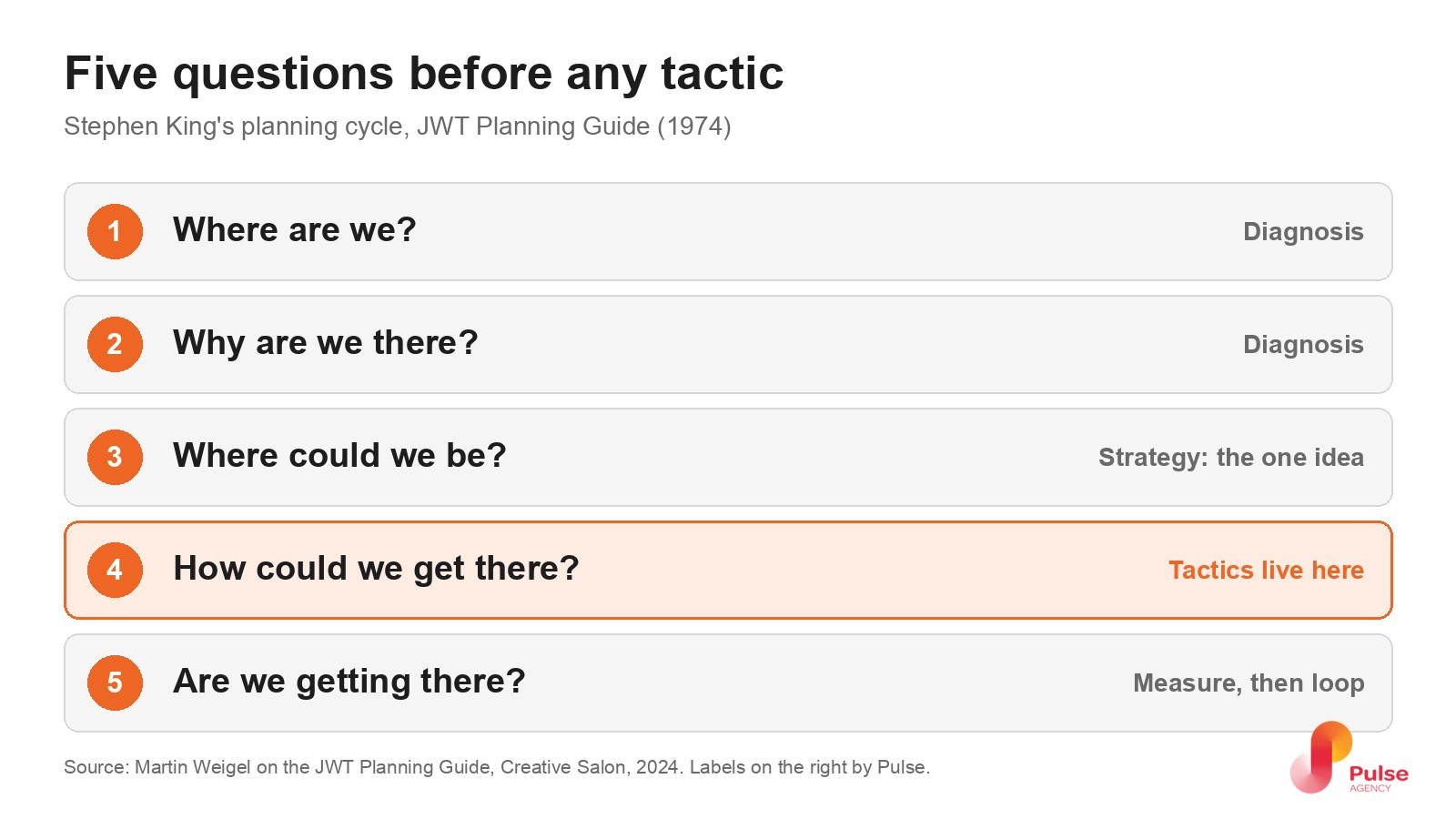
Notice where the tactics live: question four. Most marketing plans start at question four, skip the first three, and never get to the fifth.
Richard Rumelt, the UCLA strategy professor, says the same thing in Good Strategy Bad Strategy. His “kernel” of a good strategy has three parts: a diagnosis of what’s really going on, a guiding policy for dealing with it, and coherent actions that support each other. His list of bad strategy includes mistaking goals for strategy. “Rank first for plumber Sydney” and “grow traffic 30%” are goals. They don’t say how you’ll win.

Richard Rumelt · author of Good Strategy Bad Strategy
A good strategy has a diagnosis, a guiding policy and coherent actions. A goal with a to-do list isn’t one.
Photo: Financial Times, CC BY 2.0, adapted by Pulse.
Roger Martin, former dean of the Rotman School of Management, explains the difference between a plan and a strategy better than I can, in under ten minutes, on Harvard Business Review’s channel:
The one idea: what makes you the only one
Rumelt’s guiding policy is what I mean by “one idea that organises everything”. In ad agencies it’s often called the central organising idea: the thought everything hangs off, so that choosing a channel or a headline becomes obvious instead of arbitrary.
Most of the time, that idea is about positioning. Al Ries and Jack Trout argued in Positioning: The Battle for Your Mind that positioning happens in the customer’s head, not in your product: you own a distinct spot relative to the alternatives. April Dunford, whose Obviously Awesome is the most practical positioning manual I know, goes further: “Positioning is the foundation of everything we do in marketing and sales.”
Marty Neumeier’s Zag gives you a test you can do on a napkin. Finish this sentence: “Our brand is the only ___ that ___.” If you can’t, he warns in an interview about the book, “you’ll be forced to compete on price alone.”

Marty Neumeier · author of Zag
When everyone zigs, zag. If you can’t say what makes you the only one, you’ll end up competing on price.
Photo: anfas.cz, CC BY-SA 4.0, adapted by Pulse (adaptation also CC BY-SA 4.0).
Blue Ocean Strategy by W. Chan Kim and Renée Mauborgne takes it one step further: instead of fighting rivals in a crowded “red ocean”, create a space where, in their words, “competition is irrelevant”. Fighting the same ten competitors over the same keywords is about as red as an ocean gets.
Growth comes from being easy to think of and easy to find
The strongest pushback to everything above comes from Adelaide. Byron Sharp and the Ehrenberg-Bass Institute argue in How Brands Grow that brands grow mainly by winning more buyers, by being “easy to mind” and “easy to find”, and that distinctiveness (being instantly recognisable) matters more than clever differentiation that customers never notice.

Byron Sharp · Ehrenberg-Bass Institute, author of How Brands Grow
Brands grow by reaching more buyers and being easy to think of and easy to buy. Be distinctive before you try to be different.
Photo: Ehrenberg-Bass Institute, public domain, adapted by Pulse.
Sharp and Ritson come from different schools of thought on differentiation, and a small business doesn’t have to pick a side. The useful part is that both are strategy: deciding to reach more of the market and be remembered is a strategic choice, and it tells you which tactics matter. A tradie who wants to be easy to mind and easy to find needs a strong Google Business Profile, consistent branding on the ute, and to show up when people search. That’s tactics following a strategy, not tactics looking for one.
Adam Ferrier, the Australian consumer psychologist behind Thinkerbell, adds a useful twist in The Advertising Effect: design for the behaviour you want, not just the message.
And then there’s Faris Yakob. His book Paid Attention changed how I look at this whole business. His point is that attention is scarce and has to be earned, and brands earn it by what they actually do, then by talking about it. One chapter title says it all: “Do things, tell people”. The channel only carries what you did. No SEO plan or ad budget makes up for having nothing worth saying.
Faris Yakob · strategist, author of Paid Attention
Attention is earned, not bought. Do something worth noticing first; the media plan comes second.
Here he is in three minutes on the ideas behind the book:
The forest and the leaf
So is the answer to fire the specialists? No. This is where I’d push back on my own argument.
David Epstein’s Range explains why. In “kind” environments, where feedback is fast and the rules don’t change (golf, chess), early specialists win. In “wicked” environments, where feedback is slow, misleading and the rules keep shifting, people with broad experience who connect ideas across fields do better. Marketing often behaves like a wicked environment: feedback is messy, the rules shift, and causes are hard to pin down.
What the animation shows: it starts on a single leaf tagged “#1 for ‘plumber sydney'”, with a tiny specialist celebrating on it. The camera pulls back to the branch, the tree (your website), then the whole forest: competitors, customers, price, reputation, positioning and the road the market is taking. A generalist on the hill takes in the view. You need both: someone who sees the forest, and people who know every leaf.
The fix is the order. Someone owns the why and the one idea. Then the specialists own the how, and they’re far better at it than any generalist. Eaon Pritchard, a Melbourne strategist, has written often about planners who reach for borrowed tools before they understand the problem. The tools are fine. Using them before you know the problem isn’t.
A five-minute test: strategy or to-do list?
Take your current marketing plan and answer these:
- What’s going on? Can you say in two sentences why sales are where they are? If not, you don’t have a diagnosis.
- What’s the one idea? Can you finish “We’re the only ___ that ___” without it sounding like everyone else?
- Who is it for, and who isn’t it for? A strategy that suits everyone is a wish.
- What will you stop doing? If nothing comes off the list, nothing was chosen.
- Does every tactic follow from the idea? If your plan starts with a channel, it’s a to-do list.
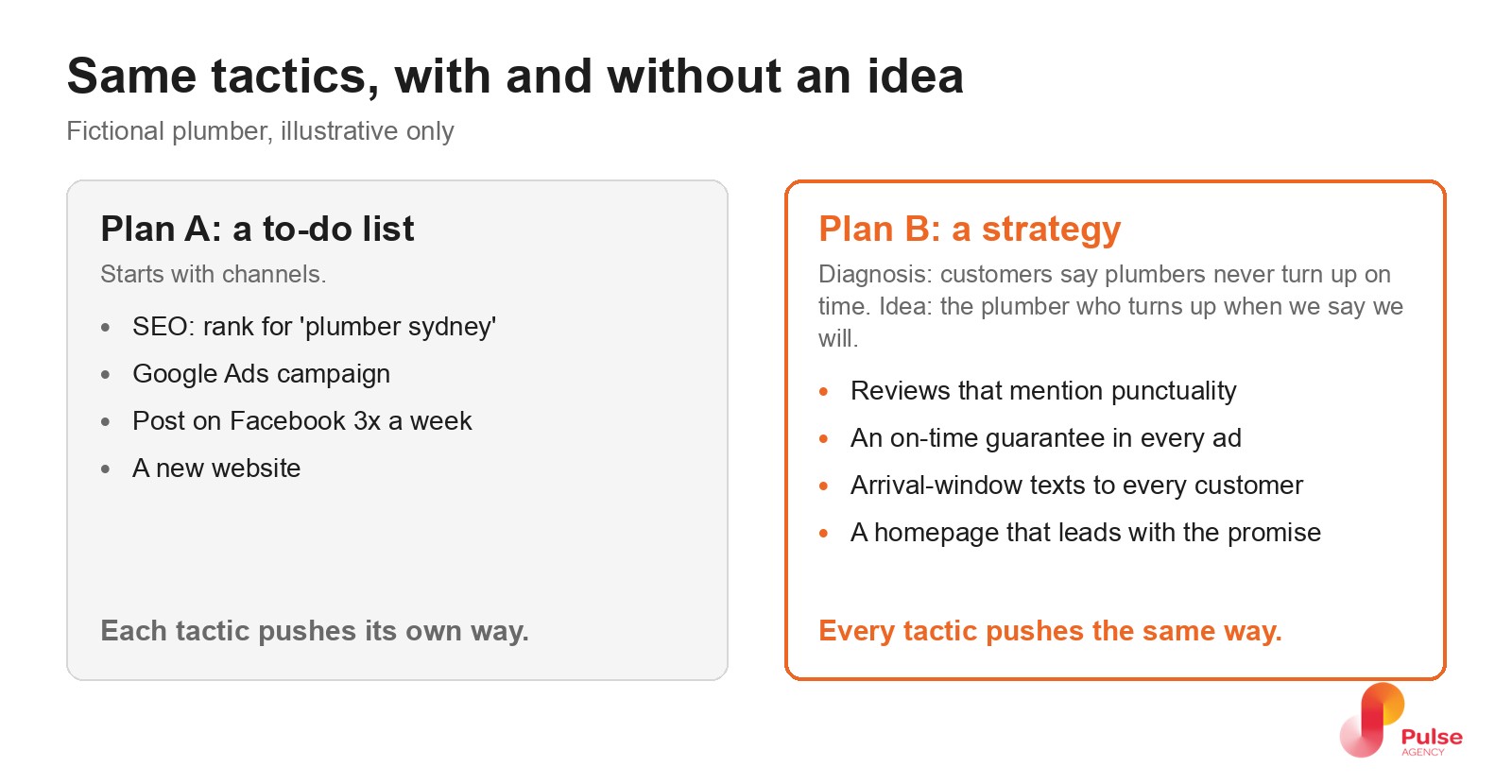
Picture a plumber. Plan A is a to-do list: SEO, Google Ads, Facebook posts, a new website. Plan B starts with a diagnosis: customers keep saying the last plumber never showed up on time. So the idea becomes “the plumber who turns up when we say we will”. Now the tactics write themselves: reviews that mention punctuality, an on-time guarantee in the ads, arrival-window texts, a homepage that leads with it. Same channels, but they all push the same way.
Where I land
After all these voices, my conclusion is simple. Ritson and Rumelt are right about the order: work out what’s going on before you choose anything. Porter and Martin are right that strategy means giving things up. Sharp is right that being easy to think of and easy to find is what grows most brands, which is why the tactics still matter. And Faris Yakob is right that no channel can carry an idea you don’t have.
Tactics aren’t the enemy. Tactics without an idea are. SEO, ads, social and a good website are how a strategy gets done, and the specialists who run them are worth every dollar when they’re pushing in a direction someone has chosen.
Before you spend another dollar on marketing, write your strategy in one sentence: what’s going on, who you’re for, and the one idea you want to be known for. If you can’t, that’s the work. If you can, every tactic gets easier to choose, and easier to say no to.
That’s what I’d want from any agency, including mine: start with what’s going on, agree on the one idea, and only then talk about channels. If you want help working out the idea before the tactics, that’s what our marketing strategy work is for. The SEO and Google Ads come after.
If budget is the constraint, my piece on choosing fewer marketing channels shows how the idea narrows the list. And if you’re in a crowded category, the NDIS differentiation article is a worked example of finding what makes you the only one.
One question for this week. If someone asked what your marketing strategy is, would you answer with an idea or with a list of channels? If it’s the list, let’s talk.
FAQ
What is the difference between strategy and tactics?
Strategy is the choice of where you’ll compete and how you’ll win: who you’re for, what you’ll be known for and what you won’t do. Tactics are the actions that deliver it, like SEO, ads, social posts or a website. In Mark Ritson’s framing, diagnosis comes first, and strategy directs the tactics.
What comes first, strategy or tactics?
Strategy, after a diagnosis of what’s really going on in the business. Richard Rumelt’s kernel of good strategy runs diagnosis, guiding policy, then coherent actions. Starting with tactics means choosing channels before you know the problem they’re meant to solve, which is how budgets get spread thin.
What does it mean to be tactical but not strategic?
It means doing lots of marketing activity without one idea tying it together: posting, running ads and publishing content because they’re on a list, not because they serve a clear choice. It usually feels busy and looks productive, but each tactic pushes in a different direction, so results don’t add up.
How does a marketing plan differ from a marketing strategy?
A marketing strategy is the idea and the choices behind it: diagnosis, target, positioning and what you’ll stop doing. A marketing plan is the schedule of tactics, budgets and dates that puts the strategy into action. A plan without a strategy is a to-do list; a strategy without a plan never leaves the meeting room.
Is SEO a strategy or a tactic?
SEO is a tactic, or a channel. It becomes valuable when it serves a strategy: the searches you target, the pages you build and the content you publish should all follow from who you’re for and what you want to be known for. An “SEO strategy” is really a channel plan inside a bigger strategy.